Dnipro Pan Film Review: a cinema film from Kyiv
Optics Lab Dnipro Pan
$13.99 · 35mm · 36 exp
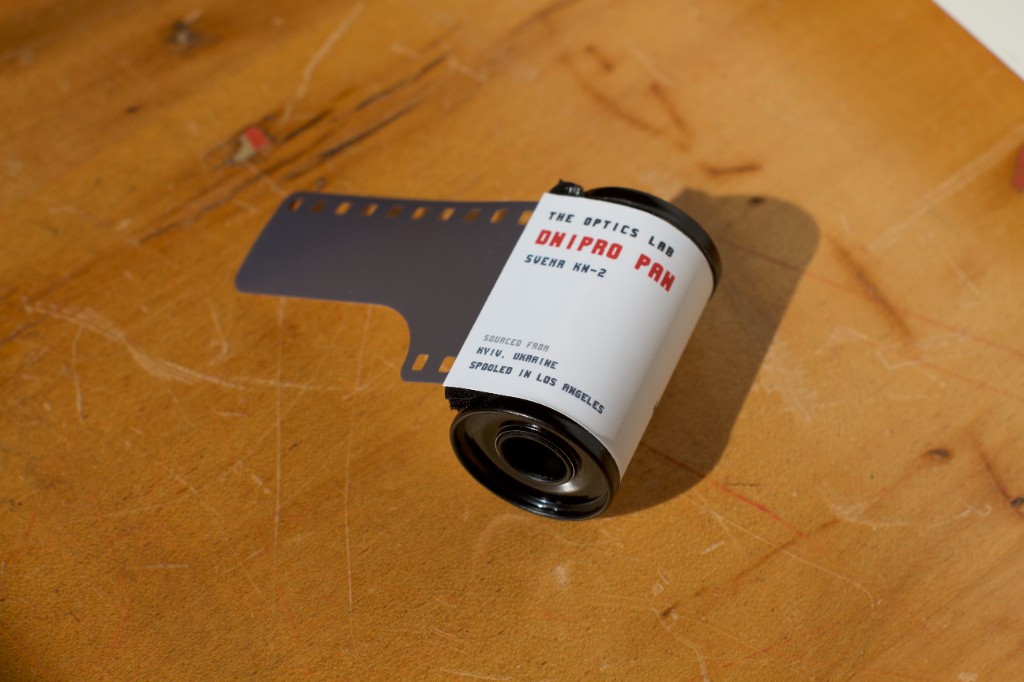
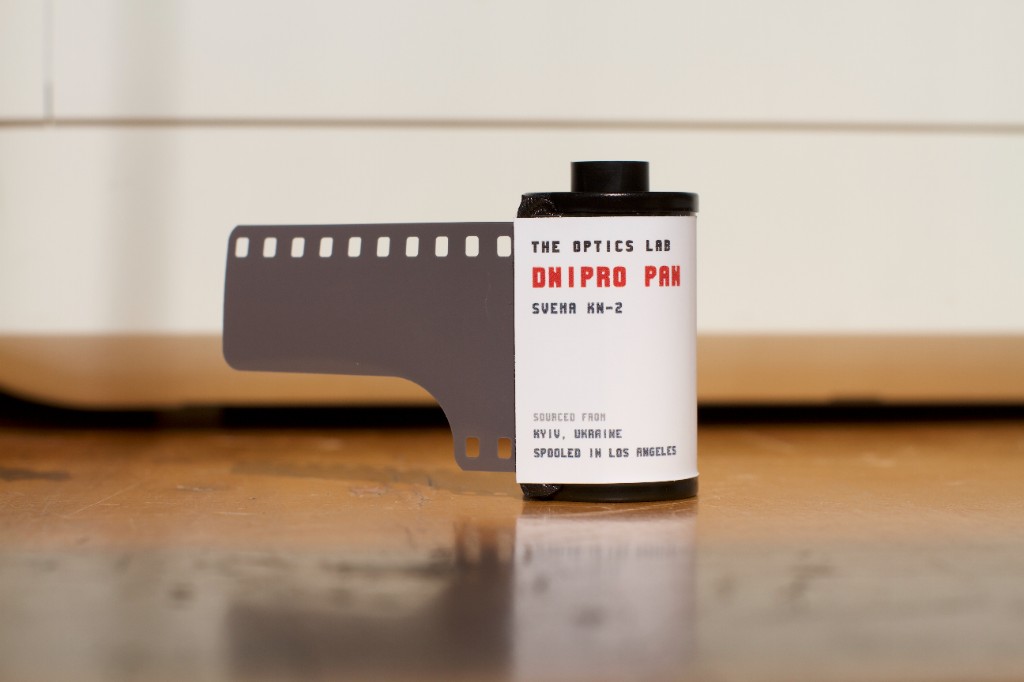
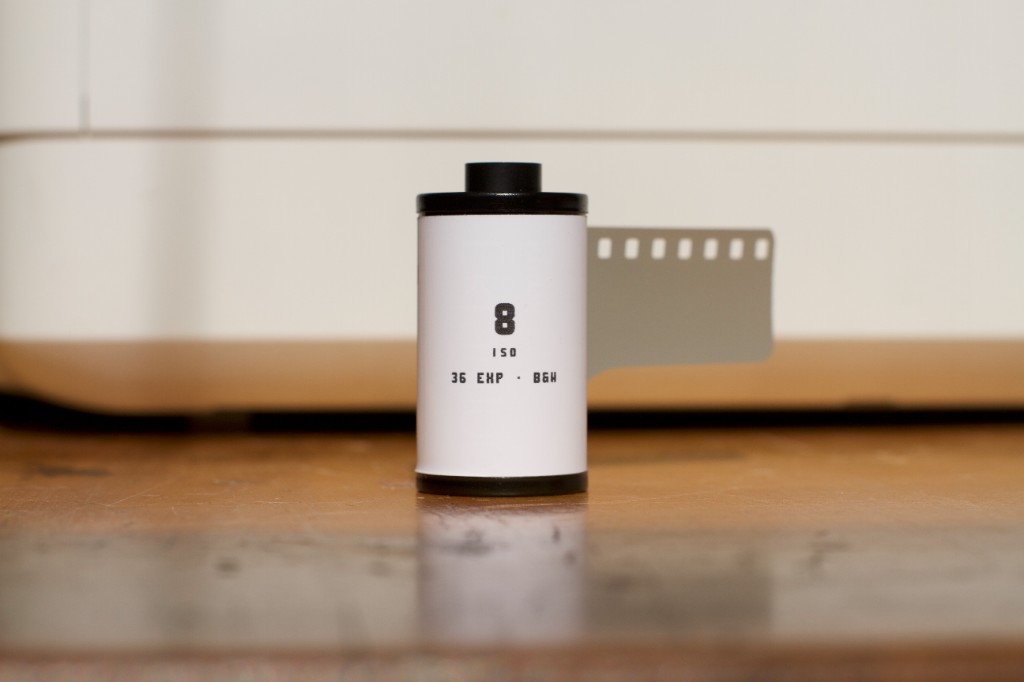
Dnipro Pan is available now in the Film Factory. This is the first roll of film produced by The Optics Lab — a slow, fine-grained panchromatic black-and-white negative based on Svema KN-2 emulsion, sourced from Kyiv, Ukraine, with batch one bulk loaded by Koltin Sullivan in Los Angeles.
This article covers the emulsion's history, what we found during testing, recommended development, and what it means to ship film out of a country at war. For quick-reference specs, see the Dnipro Pan datasheet.
The emulsion
Dnipro Pan is based on Svema KN-2, a panchromatic black-and-white negative cine film — черно-белая негативная кинопленка — manufactured by the Shostka Production Association "Svema" (Шосткинское производственное объединение "СВЕМА") in the Ukrainian SSR. The Shostka plant was the Soviet Union's primary photographic film factory, founded in 1931 in the small city of Shostka in what is now Sumy Oblast, northeastern Ukraine. The name Svema is a contraction of светочувствительные материалы — light-sensitive materials — and at its peak the factory supplied film to the entire Soviet motion picture and photographic industry.
KN-2 was the outdoor/location member of the KN series — a family of cinema negatives optimized along a speed-vs-resolution curve. KN-1 (11 GOST, 135 lines/mm) was reserved for combined/VFX work demanding the finest grain; KN-2 (32 GOST, 100 lines/mm) was the standard choice for exterior shooting; KN-3 (90 GOST, 80 lines/mm) served the studio under tungsten light; and KN-4С (350 GOST, 70 lines/mm) was the fast newsreel stock. Each step up in speed traded resolving power for sensitivity.
KN-2's purpose was to deliver the sharpest possible original camera negative for outdoor cinematography. At 100 lines/mm, it carried more detail than any Kodak camera cine stock (Plus-X 5231 resolves ~80 lp/mm; Double-X 5222 ~63 lp/mm). That resolution mattered because the original negative was just the starting point — every subsequent step in the cinema pipeline (printing an interpositive, making a dupe negative, striking release prints) lost detail. The more information the camera captured, the more survived onto the screen. KN-2 was also produced at both Svema (Shostka, Ukraine) and Tasma (Kazan, Russia); the Svema stock — which is what we carry — was generally considered the higher quality of the two.
In Soviet film classification, KN-2 is designated Панхром (panchromatic) rather than Изопанхром (isopanchromatic). The distinction matters: its spectral sensitivity is unequal, with strong response in blue-green and weaker sensitivity to red. In practice, reds render darker than you might expect — a yellow or light orange filter can help balance the response in daylight.
The film was manufactured to technical standard ТУ 6-17-445-83, codified in 1983 under Soviet industrial classification. It was produced as 35mm perforated stock in large bulk rolls, sealed in factory tins, and rated at 32 GOST when fresh. A note on that speed rating: the pre-1987 GOST sensitivity scale was not identical to ISO — 32 old GOST corresponds to approximately ISO 40. After 1987, GOST was harmonized with ISO, so 32 new GOST = ISO 32. Since KN-2 predates 1987 but our Batch 1 was manufactured in 1992 (under the new system), the original fresh speed likely fell in the ISO 32–40 range. For technical details, see the Dnipro Pan datasheet.
Two batches
We acquired KN-2 from our supplier in Kyiv across two separate batches, spanning the final years of the Soviet Union.
Batch 1 (February 1992) is from one of the final production runs. By early 1992 the Soviet Union had formally dissolved, Ukraine was newly independent, and the centrally planned film industry that had sustained Shostka was collapsing. That this emulsion was still being coated and packaged in February 1992 speaks to the inertia of the factory — the machines kept running even as the system that fed them fell apart. This is the first batch we are bringing to market.
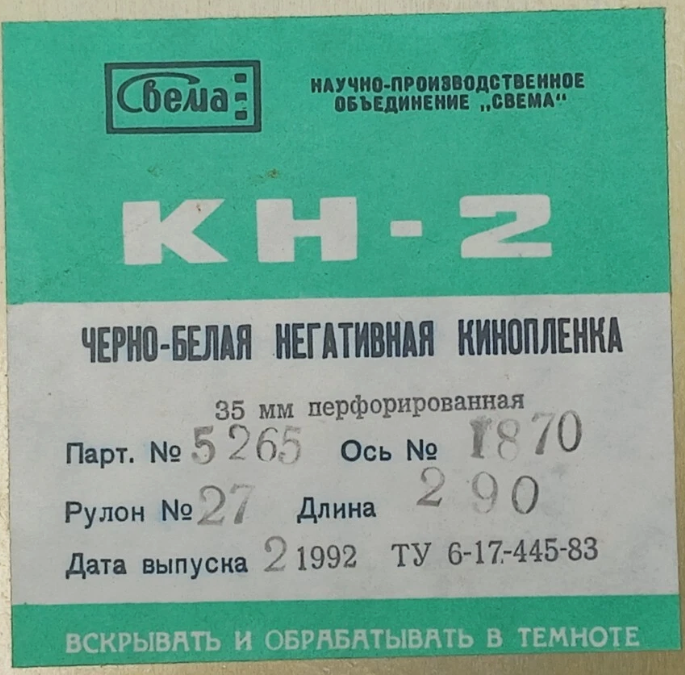 Factory label from the Batch 1 tin. Научно-производственное объединение "СВЕМА" — Scientific-Production Association "Svema." Batch no. 5265, axis no. 1870, roll no. 27, 290 meters of 35mm perforated stock, production date February 1992, ТУ 6-17-445-83.
If you know how to read Soviet industrial naming conventions, this label tells a story beyond what's printed on it. Compare it to Batch 2's tin from 1987: that label identifies the manufacturer as the Шосткинское производственное объединение "СВЕМА" — the Shostka Production Association. A производственное объединение (ПО) was the standard Soviet organizational form for large industrial enterprises — a centrally managed group of factories and workshops operating under a plan handed down from the ministry, with the city name anchoring it to place.
By February 1992 the label reads Научно-производственное объединение "СВЕМА" — Scientific-Production Association. The city name is gone. The designation has changed from ПО to НПО, a form that formally integrated research and development with manufacturing. An НПО carried more prestige — it signaled serious scientific and engineering capability, not just production lines. This kind of reorganization was characteristic of perestroika: through the late 1980s, Gorbachev's reforms encouraged enterprises to modernize and prepare for a world where the state would no longer dictate what to produce and who to sell it to. Many factories adopted the НПО designation during this period, sometimes reflecting genuine integration of research capacity, sometimes reflecting bureaucratic positioning in a system that was rapidly losing coherence.
For Svema the timing is stark. The factory adopted this forward-looking designation at almost exactly the moment when the infrastructure that gave it meaning was disintegrating. The USSR had been formally dissolved for two months. The centralized planning system that had sustained Shostka — guaranteeing raw materials, setting quotas, distributing film to studios across the Soviet Union — was gone. The label represents an enterprise reaching for a modern identity in a country that had just been born, using bureaucratic language from a country that had just died.
Batch 2 (August 1987) arrived in an original factory-sealed tin — the kind of packaging that hasn't been produced in nearly four decades.
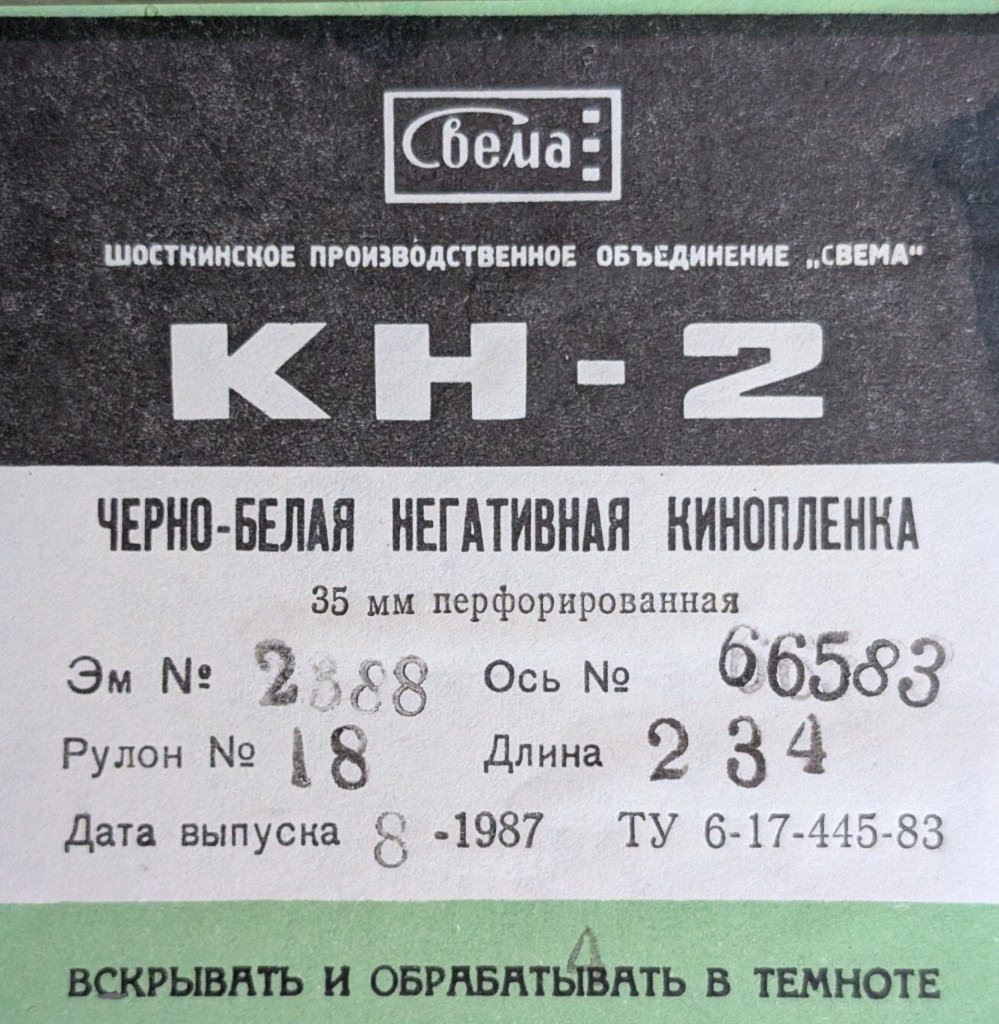 Factory label from the Batch 2 tin. Шосткинское производственное объединение "СВЕМА" — Shostka Production Association "Svema." Emulsion no. 2388, roll no. 18, 234 meters, production date August 1987. ВСКРЫВАТЬ И ОБРАБАТЫВАТЬ В ТЕМНОТЕ: open and process in darkness.
In August 1987 the renaming described above was still in the future. Gorbachev had been General Secretary for two years. Glasnost was opening Soviet public life, but the political crisis that would dissolve the Union was still four years away. The Shostka plant was operating at full capacity, embedded in the centrally planned system, fulfilling its role as the primary supplier of cine stock to Soviet studios. The film in this tin was coated in a world that still assumed the Soviet Union would exist indefinitely.
The seal was intact when it reached us. For photographic film, factory-sealed storage over this kind of timeframe is exceptional — it eliminates moisture and atmospheric oxidation, the two main enemies of emulsion longevity. Whatever sensitivity loss this stock has accumulated over nearly four decades came from the slow thermodynamic drift of silver halide crystals, not from environmental exposure. That the emulsion is still usable and still capable of producing clean images speaks to how well it was stored.
We will make batch 2 available at a later date as our supply of batch 1 winds down.
Both batches have been stored in Ukraine for over three decades. After that time, the effective sensitivity has settled to approximately 5–8 ISO. Fog remains minimal and frame numbers are clearly legible on the rebate. The emulsion is remarkably well-preserved given its age.
Test results
For testing and bulk loading, we turned to Koltin Sullivan — a Los Angeles-based analog portrait photographer and darkroom specialist who studied Cinematic Arts at Cal State Fullerton and cut his teeth on American Film Institute productions before spending three years on the team at CineStill, where he was surrounded by some of the best minds in analog film manufacturing. Koltin now runs his own operation — respooling motion picture stock, mixing custom ECN-2 chemistry, and processing and scanning everything in-house. He's worked with emulsions as obscure as 65mm IMAX negative cut down and respooled onto 120 paper, so a Soviet-era KN-2 cine stock was right in his wheelhouse.
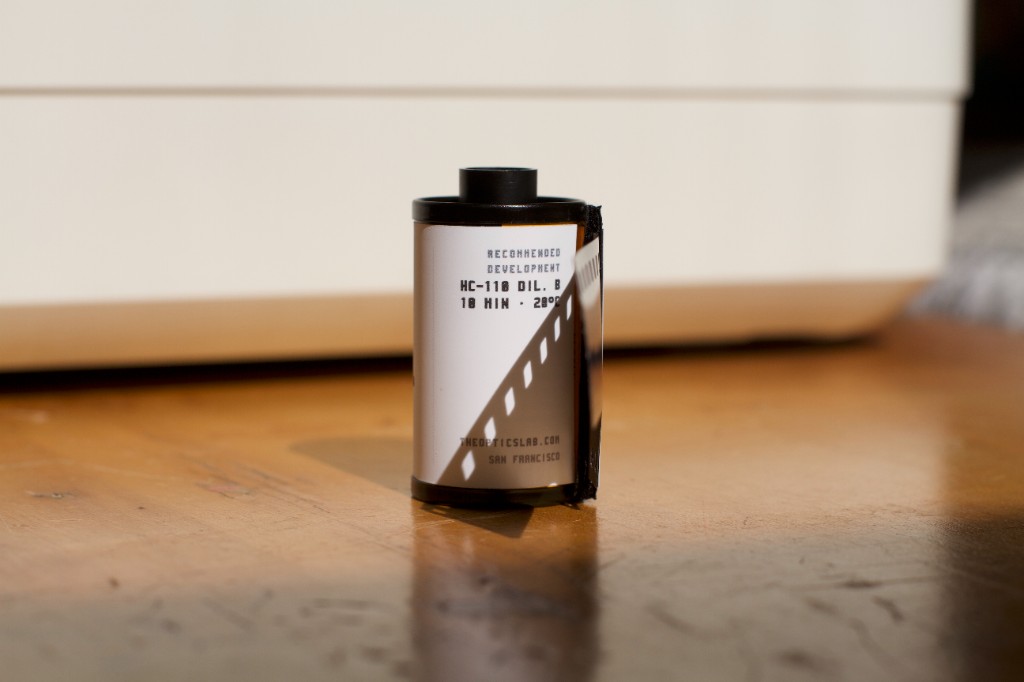
Koltin loaded the entire reel into 12 rolls of 36 exposures, reserving about a foot of film for his own testing. He processed the test strip in HC-110 Dilution B for 10 minutes with distilled water.
Koltin shot a series of frames against a DKK (Digital Kolor Kard) reference panel to evaluate tonal reproduction and exposure accuracy. The first three frames were exposed at 1/30 sec, f/2.8; the second three at 1/30 sec, f/4.0. His meter reading for the scene was 1/30 at f/4.0 at ISO 100.
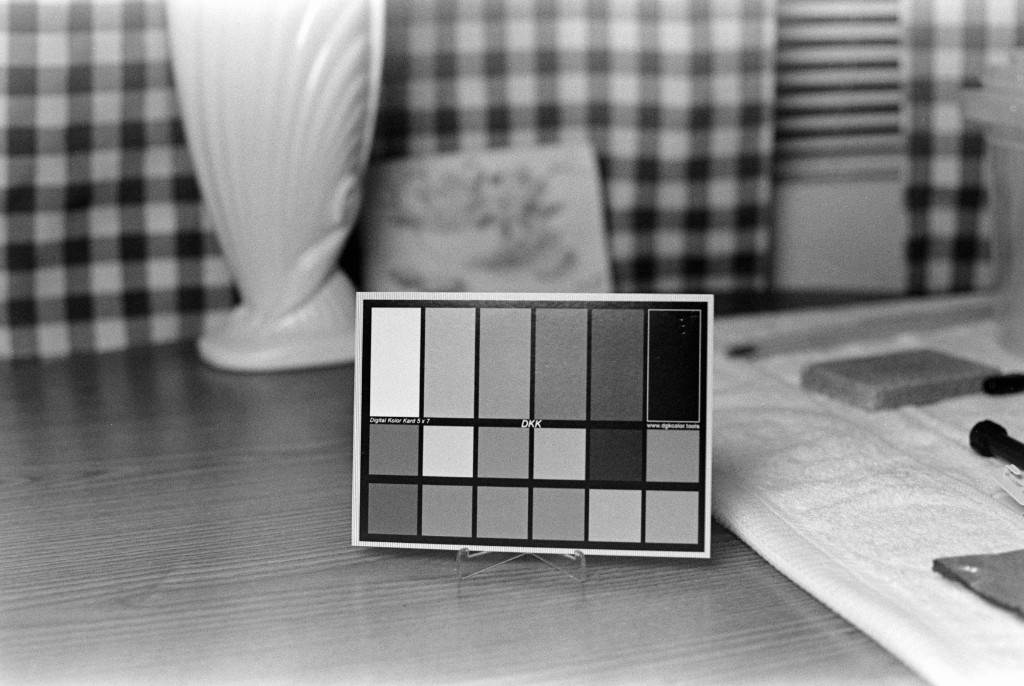 DKK reference card, 1/30 sec at f/2.8. HC-110 Dil. B, 10 min.
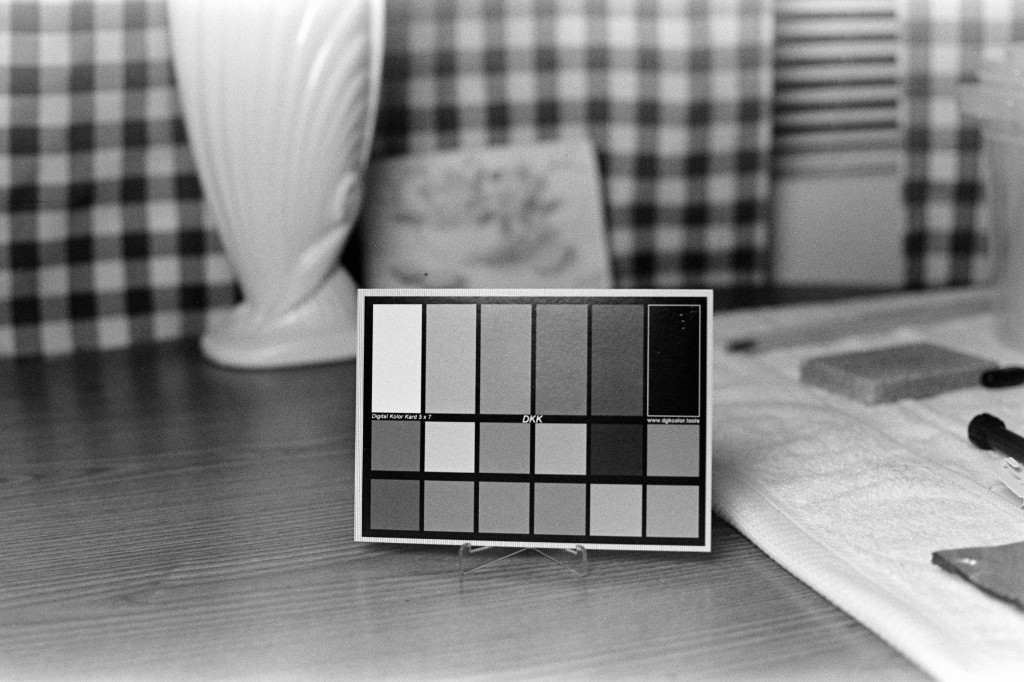 Same card, 1/30 sec at f/4.0 — the metered exposure. Tonal separation across the full grayscale is smooth and well-defined at both apertures.
His findings: good sharp images even after more than three decades. No scratches on the emulsion. Some edge fogging is present — not uncommon with expired stock stored for this long, where the outermost wraps of the roll receive slightly more ambient exposure over the years than the tightly wound interior. A few frames also show faint x-ray artifacting, likely picked up during international transit.
A note on speed
An attentive reader might notice a discrepancy: if the film's effective speed is 5–8 ISO, why did Koltin meter the scene at ISO 100? He wasn't rating the film at 100 — he was reporting what his light meter recommended for the scene at that sensitivity as a reference point. By shooting at those settings on a film that is actually 4+ stops slower, he was deliberately overexposing by roughly four stops.
This is standard practice with expired stock, and especially important with slow black-and-white negatives. B&W negative film has enormous latitude on the overexposure side — you can give it several stops more light than the "correct" exposure and still get usable, often excellent, results. Underexposure is far less forgiving. With expired emulsions that have lost sensitivity over decades, erring heavily on the side of overexposure ensures that the latent image is strong enough to rise above any accumulated base fog.
The fact that Koltin's frames came out sharp with clean tonal separation — rather than blowing out into featureless white — actually confirms the supplier's estimate. A true ISO 100 film given this much light would have been hopelessly overexposed. Dnipro Pan absorbed four extra stops and produced exactly the kind of smooth, well-separated results you want from a cine emulsion built for resolution.
Supplier test shots — Kyiv
Our supplier in Kyiv also shot and processed test frames from the same stock. These were developed in D-19, a high-energy developer that pushes contrast harder than HC-110 — notice the deeper blacks and more pronounced tonal separation compared to Koltin's results above.
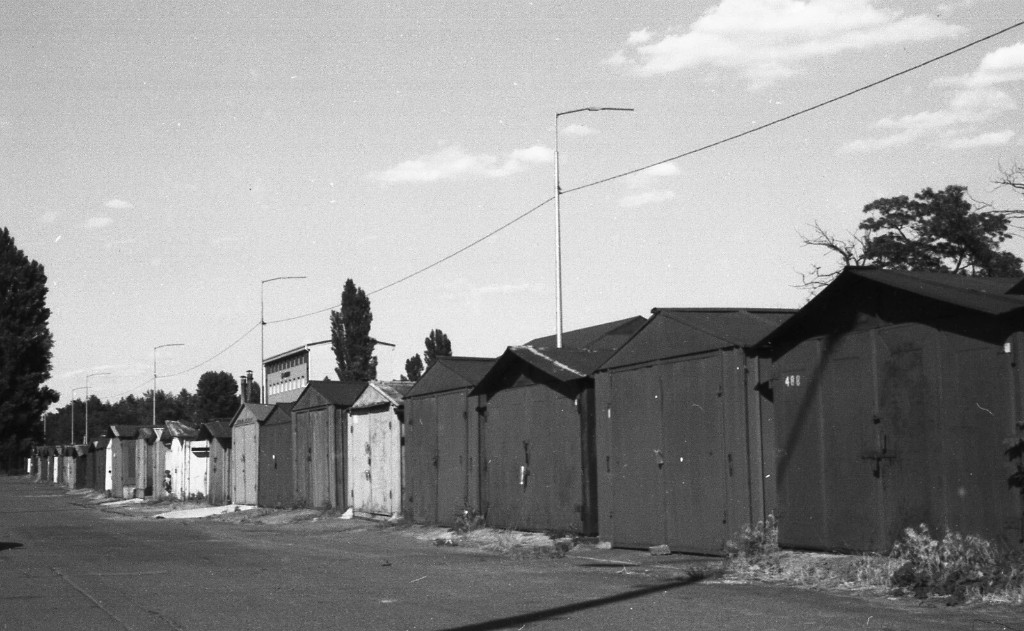 Shot in Kyiv on Svema KN-2 (Batch 1). Developed in D-19.
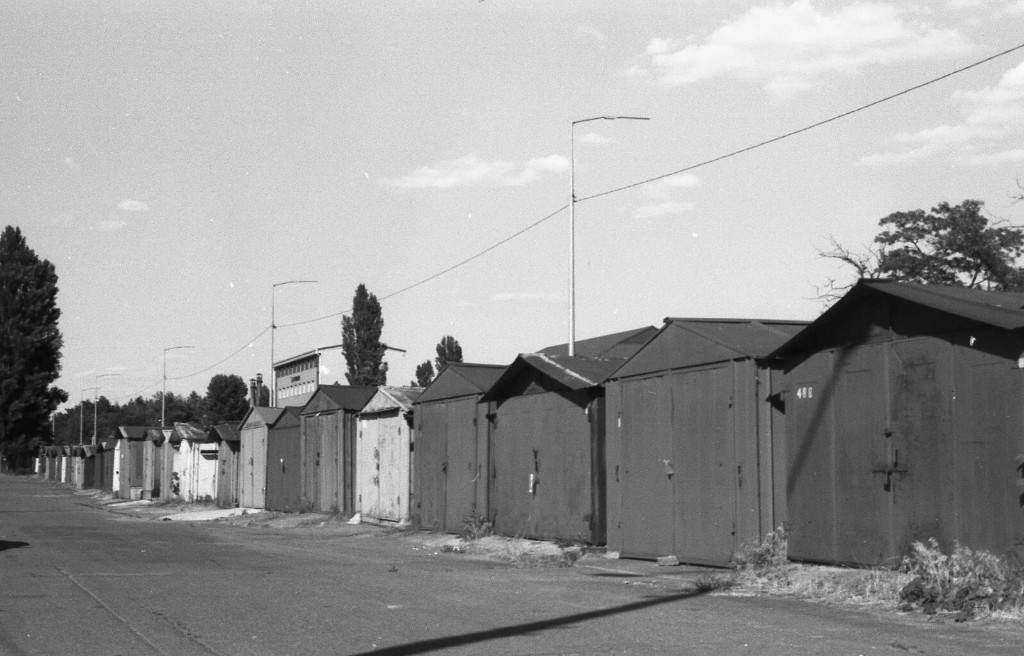 Same scene, second scan. The emulsion holds detail across the full range — shadow texture in the garage doors, highlight separation in the sky.
 Contact strip showing four consecutive frames. Consistency across the strip is excellent — no fog buildup, clean frame spacing.
The difference between these frames and Koltin's HC-110 results illustrates how much developer choice shapes the final image. D-19 delivers a punchy, graphic look; HC-110 gives smoother, more gradual tonality. Both are valid starting points — you can dive in more deeply into technical development notes in our datasheet.
What to expect
KN-2 is a slow film, but "slow" doesn't have to mean difficult. At an effective speed of 5–8 ISO, a sunny day gives you plenty to work with — bright overcast or direct sun puts you comfortably in the range of 1/60 at f/8 or faster, which is perfectly handheld territory. You don't need a tripod for every frame. What you do need is light, and an awareness of how much of it you have.
That said, the pace of shooting does change. You become more selective, more deliberate. You start reading the light before you raise the camera. For a lot of photographers, this turns out to be the best part of shooting a film like this — it brings you back to the fundamentals in a way that faster stocks don't demand.
What you get in return is exceptional:
- Extremely fine grain — finer than most modern 100-speed films. At this speed class, grain essentially disappears. Scans hold remarkable detail at high magnification.
- High resolving power — 100 lines/mm per Soviet specification, higher than any Kodak camera cine stock. You will see edge detail and micro-contrast that faster films cannot match.
- Long, smooth tonal scale — the characteristic curve is gentle and forgiving in the highlights, with rich shadow separation. This emulsion holds information across a wide range of densities without clipping.
The overall rendering is quiet and precise. Compared to a modern film like Ilford Pan F Plus, KN-2 has a slightly different tonal palette — less contrast in the midtones, more information held in the extreme highlights — and a textural quality that feels distinctly analog in a way that newer emulsions have engineered out.
If you've never shot anything this slow, don't be intimidated. The worst thing you can do with Dnipro Pan is underexpose it. Give it light and it will reward you.
Development recommendations
Dnipro Pan is a standard silver gelatin B&W negative — it processes in any conventional black-and-white developer and does not require special chemistry. No remjet, no unusual base. If you can develop Tri-X, you can develop this.
Safelight: none. Dnipro Pan is panchromatic — it sees all colors of visible light, including red. Load your developing reels and handle the film in total darkness until it is fully fixed. No safelight of any color is safe.
Tested
- HC-110 (Dilution B) — 10 minutes at 20°C, distilled water. This is our confirmed starting point, tested by Koltin Sullivan on Batch 1 film. Results were clean with smooth gradation across the full tonal range. If you're developing your first roll of Dnipro Pan, start here.
Suggested starting points
The following developers have not been tested on our specific batches but are well-matched to this type of emulsion:
- D-76 / ID-11 (stock) — the universal starting point for any B&W film. Try rating at ISO 6 and developing for approximately 8–10 minutes at 20°C. D-76 is forgiving with expired emulsions and will give you a full tonal range with fine grain.
- Rodinal (1+50) — a high-acutance developer that will emphasize edge sharpness and bring out the full resolving power of the emulsion. Grain will be slightly more visible than with D-76 or HC-110, but on a film this slow and fine-grained, the increase is negligible. Good choice if you want the maximum perceived sharpness from your scans or enlargements.
- D-19 — our supplier in Kyiv tested the film in D-19, a high-energy developer originally designed for scientific and technical applications. D-19 compensates aggressively for reduced sensitivity, which makes it useful for pushing extremely expired stock, but it produces high contrast. Not our first recommendation for pictorial work.
General guidance
- Agitation: standard — continuous for the first 30 seconds, then gentle inversions for 10 seconds every minute.
- Stop bath: water stop or dilute acetic acid, either works.
- Fixer: any standard rapid fixer. Fix for the recommended time; this emulsion clears quickly.
- Temperature: maintain 20°C (68°F). The emulsion is thin and responsive to temperature shifts, so consistency matters more than usual.
- Overexpose, don't overdevelop: if you're unsure about your exposure, err on the side of giving the film more light rather than extending development time. Pushing development raises contrast and fog; generous exposure preserves the smooth tonal scale that makes this emulsion worth shooting.
This article serves as our development and metering reference for Dnipro Pan — we'll update it as we test additional developers. We recommend bookmarking it or pulling it up before your first roll.
From Kyiv
The film ships to us from a supplier in Kyiv via Ukrposhta — Ukraine's national postal service. This is not a detail we take lightly. As of this writing, Ukraine remains at war with Russia. Our supplier packs and ships these rolls under the same skies that see Patriot intercepts and Shahed drone strikes.
The logistics chain is real and traceable. Batch 1 was accepted at a branch office in Kyiv on a Saturday afternoon in May 2026. By Sunday it had moved through multiple logistics centers across the city before being processed through Ukrposhta's KIEV PI-1 and PI-2 international facilities, cleared customs, and was handed to a carrier for the flight out. It landed at the USPS facility in Bell Gardens, outside Los Angeles, a week later. From there it moved through the LA distribution center, up to San Francisco, and was delivered to our door in the Inner Sunset two weeks after it left Kyiv. Batch 2 followed the same route a few weeks later — accepted in Kyiv on a Monday, processed through KIEV PI-1 and PI-3, and delivered in San Francisco nine days later.
We mention the route not for drama but for context. The provenance of this film is unusual. It was manufactured in the final days of the Soviet Union, stored through three decades of Ukrainian independence, and is now leaving the country during a full-scale invasion — carried by the same postal workers who keep Ukraine's mail moving through wartime. That history is part of what makes it worth shooting.
The name — Dnipro Pan — comes from the Dnipro, Ukraine's great river. It runs through Kyiv and the heart of the country, linking the history of this emulsion to the land it comes from. Pan is panchromatic — sensitive to the full visible spectrum.
Availability & pricing
Batch 1 (February 1992 emulsion) is the first to market — 35mm (135 format), 36 exposures, not DX coded. $13.99 per roll. 11 rolls available at time of publication in the Film Factory.
Batch 2 (August 1987 emulsion) availability date subject to demand. Sign up for our newsletter for restock alerts and new Film Factory releases.
Optics Lab Dnipro Pan
$13.99 · 35mm · 36 exp