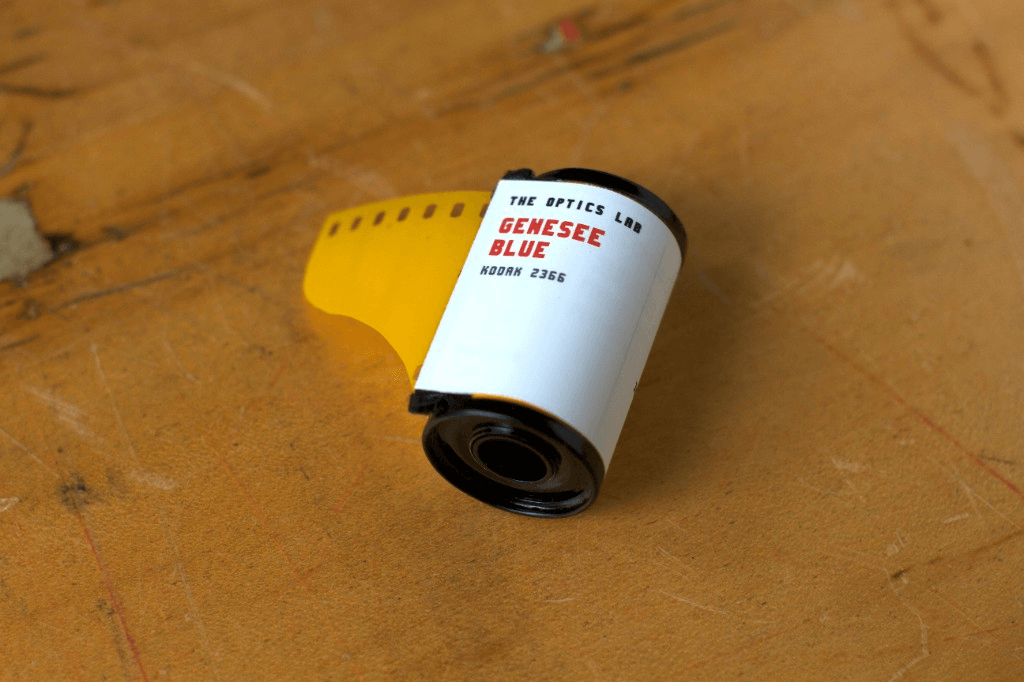
Optics Lab Genesee Blue
B&W · ISO 6 · 135 format
Genesee Blue is based on Eastman 2366 — Kodak's fine grain duplicating positive, a motion picture intermediate stock still manufactured in Rochester. It was designed to make the first faithful copy of an irreplaceable camera negative in the cinema duplication chain. Every attribute of the emulsion — the ultra-fine grain, the extreme resolving power, the steep contrast, the very slow speed — exists to serve that function.
What makes 2366 unusual for still photography is its spectral sensitivity. It is not panchromatic. It is not even orthochromatic. It is blue-sensitive only — responsive to violet and blue light, dropping off sharply around 500nm. Green, yellow, and red are essentially invisible to the emulsion.
The result is a tonal world unlike anything a panchromatic film can produce. Blue skies render luminous and bright. Foliage goes dark — sometimes nearly black. Red objects disappear into shadow. The contrast between sky and land is dramatic and graphic in a way no filter on a pan film can replicate, because the spectral cutoff is genuinely hard.
Native contrast is high — Kodak specifies a gamma of 1.20 to 1.60. In standard still developers (D-76 1+1, HC-110 Dil. B), the images are bold: deep blacks, bright highlights, a compressed midtone range. This is the film doing what it was designed to do.
Grain is virtually invisible. Kodak specifies RMS granularity of 9 and resolving power up to 200 line pairs per millimeter — comparable to T-Max 100, one of the finest-grained pictorial films ever made.
The film is coated on a clear polyester (ESTAR) base — dimensionally stable, archivally excellent, immune to vinegar syndrome. The unprocessed strip is a vivid yellow from an anti-halation dye that is removed during fixing. Because the film is blue-sensitive only, it can be handled under a Kodak OC safelight (greenish-yellow) at 4 feet.