Eastman 2366 Film Review: The Film That Sees Only Blue
Optics Lab Genesee Blue
$11.99 · 35mm · 36 exp
The first thing you notice about a strip of Eastman 2366 is the color. Not the image — the film itself. Before exposure, before processing, the strip is a vivid, almost custard yellow, bright enough to look wrong if you've spent any time handling conventional black-and-white film. Tri-X is grey-purple. T-Max is faintly lavender. HP5 is a dark neutral. Eastman 2366 looks like a strip of candy. It is, objectively, pretty cool.
The yellow is not a base tint. It is a dye — deliberately incorporated into the emulsion to improve acutance, and deliberately removed during processing. When the film comes out of the fixer, the yellow is gone and the ESTAR base is nearly water-clear. But on the roll, in the cassette, held up to the light in a darkroom, 2366 is unmistakably, cheerfully yellow.
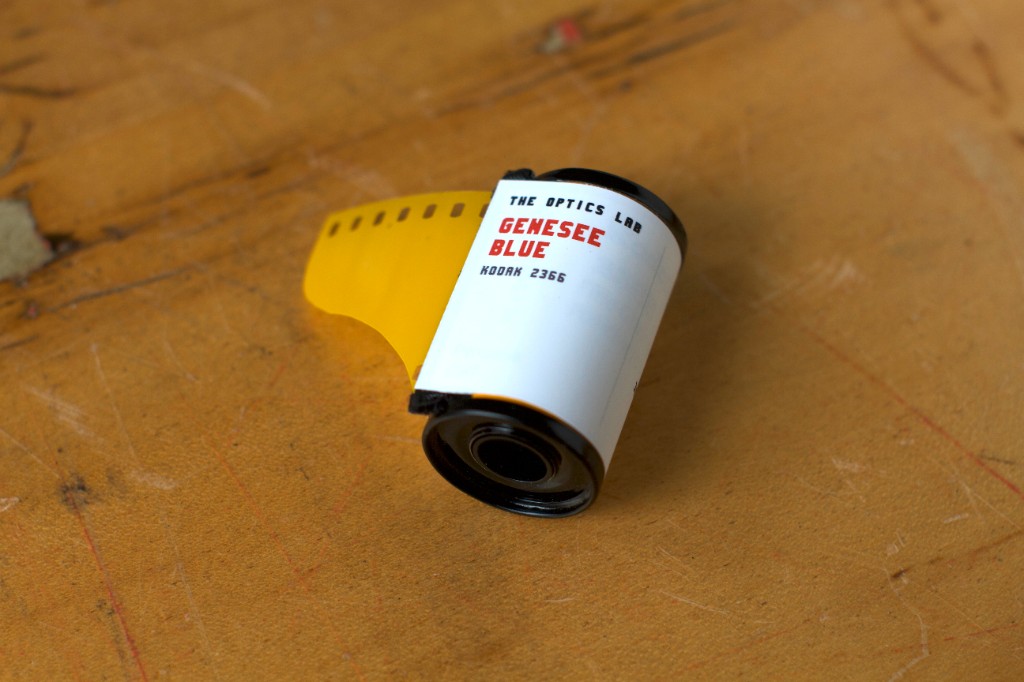
That color is one of several things about this film that mark it as something from outside the world of conventional still photography. Eastman 2366 was not designed to go into cameras. It was designed to go into contact printers. The fact that it works in cameras — and works, in certain conditions, beautifully — is a consequence of the same engineering precision that makes it excellent at its intended job.
What duplicating positive film actually does
To understand what 2366 is, you need to understand the problem it was built to solve.
In motion picture post-production — the traditional photochemical workflow that governed cinema from roughly the 1920s through the early 2000s — the original camera negative is irreplaceable. A director of photography exposes exactly one strip of film in the camera. If that negative is damaged, there is no backup. So the entire theatrical distribution chain was designed to protect it.
The solution is duplication. The original camera negative is contact-printed onto a fine grain master positive — a high-resolution positive image on very fine-grained film. That master positive is then contact-printed onto a panchromatic duplicating negative film (Kodak's companion product, Eastman 2234 or 5234) to produce a duplicate negative. The duplicate negative is what gets sent to release print labs. The original camera negative goes into a vault.
Kodak's specification for this chain is exacting: the duplicate negatives produced through the master positive intermediate should be "only distinguishable from the originals by skilled observers." That is, the duplication path should introduce no visible degradation — no added grain, no lost detail, no contrast shift that an experienced technician would notice.
Eastman 2366 is the master positive stock in this chain. It is the film that makes the first faithful copy. Every attribute of the emulsion — the ultra-fine grain, the high resolving power, the carefully specified contrast, the very slow speed — exists to serve that single function: receive a contact exposure from a camera negative and hold the image with the highest possible fidelity until it can be printed onto the next generation.
That is why the film is the way it is. And it is also why, when you put it in a 35mm camera and point it at the world, the results look the way they do.
Blue-sensitive means exactly what it says
Most black-and-white films in current production are panchromatic — sensitive across the full visible spectrum, from deep violet through red. When you photograph a red barn against a green field on Tri-X, both the barn and the field register as grey tones because the emulsion responds to both wavelengths.
Eastman 2366 is not panchromatic. It is not even orthochromatic, which would give it sensitivity through the green portion of the spectrum. It is blue-sensitive — responsive only to violet and blue light, dropping off sharply somewhere around 500 nanometers. Everything from green through red is essentially invisible to the emulsion.
The spectral sensitivity chart below makes this concrete. The upper curve is Kodak T-Max 100 — a modern panchromatic film with useful sensitivity from deep UV through roughly 650nm, covering the entire visible spectrum. The lower curve is Eastman 2366. It rises through UV and violet, peaks in the blue, and falls off a cliff before it reaches green. The gap between the two curves across the green, yellow, and red portions of the spectrum is not a subtle difference in speed — it is the difference between seeing and not seeing.
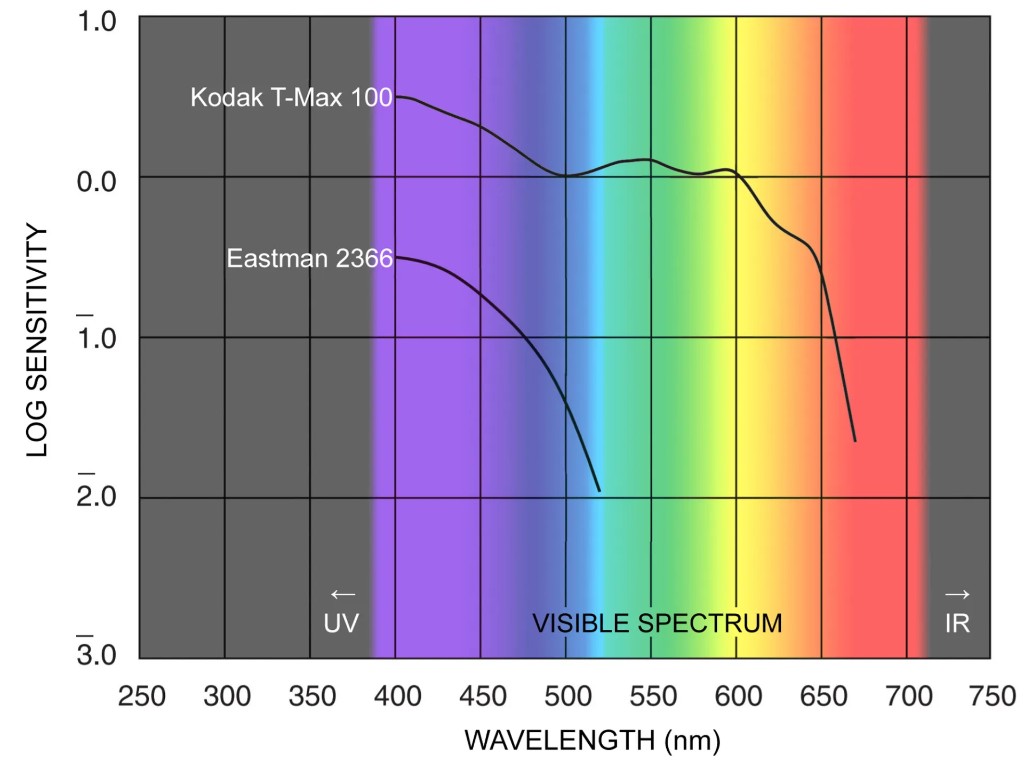
In the motion picture duplication chain, this is not a limitation. A black-and-white camera negative is being contact-printed under a controlled tungsten lamp with known spectral characteristics. The light passing through the negative carries the image information as variations in density, and the blue-sensitive emulsion records those density variations faithfully. The color of the original scene is irrelevant — it was already translated into silver densities by the camera negative.
In a still camera pointed at the world, blue sensitivity changes everything.
A blue sky registers as a bright, luminous tone — the film sees it directly and eagerly. Skin renders pale and somewhat ethereal, because the blue component of skin reflectance is lower than what a panchromatic film would record, and the red and yellow components contribute nothing. Green foliage goes very dark, sometimes nearly black, because the film cannot see green light. Red objects — a stop sign, a brick wall, a pair of lips — go completely dark, rendered as near-black regardless of how bright they appear to the eye.
The result is a tonal world that looks unlike any panchromatic or orthochromatic film. Skies are luminous. Shadows are deep. Foliage is ink. The contrast between a blue sky and a dark tree line is dramatic and graphic in a way that no yellow or red filter on a panchromatic film can replicate, because the spectral cutoff is genuinely hard — the film is not attenuating green and red, it is blind to them.
This is the most distinctive thing about shooting 2366 pictorially, and it is either a limitation or a feature depending on what you want. For landscapes, architecture, and high-contrast graphic work in direct sunlight, the blue-only rendering produces images with a quality that sits somewhere between photography and printmaking. For portraits or any subject that depends on accurate tonal relationships between warm and cool colors, the rendering is alien and requires either commitment or correction.
The yellow dye and what it does
The yellow dye that gives the unprocessed film its striking appearance serves a specific optical function: it acts as an anti-halation measure and acutance enhancer within the emulsion. When light enters the emulsion during exposure, some of it would normally scatter and reflect off the base, creating halos around bright points and slightly softening edge definition. The yellow dye absorbs stray blue light within the emulsion layer, preventing internal reflections and scatter. The result is higher acutance — sharper edges, finer detail, crisper transitions between light and dark.
Because 2366 is blue-sensitive, a yellow dye is the correct choice. Yellow absorbs blue and passes red and green, which means it intercepts exactly the wavelengths the emulsion responds to without interfering with wavelengths the emulsion ignores. In processing, standard fixing removes the dye along with unexposed silver halide, leaving the clear ESTAR base.
Grain, resolution, and the polyester question
The grain on 2366 is, for practical purposes, invisible. Kodak specifies an RMS granularity of 9 and resolving power up to 200 line pairs per millimeter. For comparison, T-Max 100 — one of the finest-grained pictorial films ever made — has an RMS granularity of 8 and resolves 200 lp/mm. The two films are in the same territory, which is not surprising: both are built to hold maximum information in a 35mm frame, albeit for completely different reasons.
The film is coated on a clear ESTAR base — Kodak's trade name for polyester (PET). This is standard for motion picture film and has practical consequences for still photography. Polyester is dimensionally stable, archivally excellent, immune to vinegar syndrome, and extremely durable. It also will not tear. If a film advance jams, triacetate base film will snap at the sprocket hole, limiting the damage to the film. Polyester base film will not snap. It will strip the sprocket teeth or damage the camera mechanism. This is a real consideration: load carefully, advance smoothly, and do not force anything.
The polyester base does scan cleanly — no curl, no channeling in glass carriers, and a near-transparent base that makes densitometry straightforward.
Contrast, developers, and D-97
The native contrast of 2366 is high. Kodak specifies a control gamma of 1.20 to 1.60 for its intended duplication work — considerably steeper than the 0.55 to 0.70 gamma range typical of pictorial negatives. When you develop 2366 as a negative in standard still-photography chemistry, the resulting images are contrasty: deep blacks, bright highlights, a compressed midtone range, and a tonal curve that clips more aggressively than a conventional pictorial film.
This is not a defect. It is the film doing what it was designed to do — produce a high-fidelity positive with strong density separation. When repurposed as a camera negative, that same steep curve translates into bold, graphic images with a visual impact that softer-contrast films don't deliver.
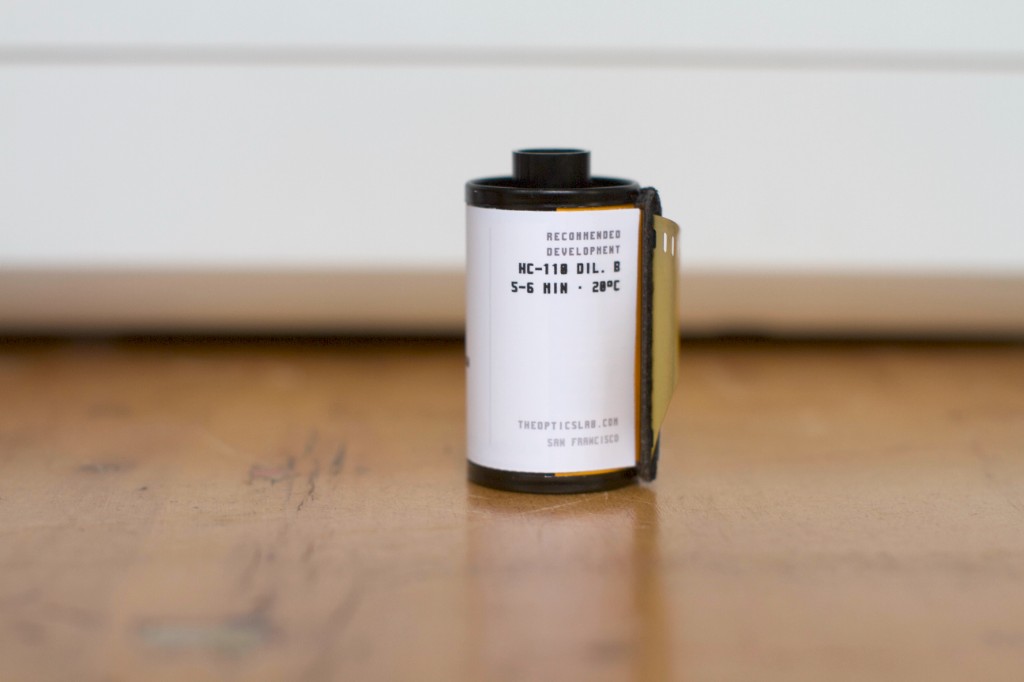
Look at the label on the cassette: Process D97. In Kodak's motion picture system, D-96 and D-97 are companion developers published side by side in the H-24.15 processing manual, each designed for a different class of film. D-96 is the negative developer — a moderate-contrast MQ formula built with borax as its accelerator, similar in character to D-76, designed to keep negative contrast under control for printing. D-97 is the positive developer — it uses sodium carbonate, pushes the pH above 10, and develops to substantially higher contrast. It is closer in character to a paper developer like Dektol than to the gentle negative developers most still photographers are familiar with.
The cassette says D-97 because 2366 is a positive film, and D-97 is Kodak's specified process for positive stock. But that does not mean D-96 is off the table. Both developers work with this emulsion — D-97 delivers the full native contrast the film was designed for, while D-96 produces a gentler result closer to what you would expect from a conventional negative developer. The choice depends on whether you want to lean into the film's steep contrast or pull it back toward pictorial territory.
For still photographers, both D-96 and D-97 can be hard to source. Most pictorial work with 2366 uses more widely available developers, and the results are excellent:
D-76 (1+1) at approximately 8.5–10 minutes at 20°C is a reliable starting point — good tonal range, fine grain, and enough development activity to build useful shadow density without blowing the highlights entirely.
HC-110 (Dilution B) at approximately 5–6 minutes at 20°C produces smooth, slightly creamy results. Several photographers who have tested this film extensively report HC-110 as their preferred developer for pictorial work.
Rodinal (1+50) at approximately 8–9 minutes at 20°C delivers maximum acutance, emphasizing the film's already-exceptional sharpness, with slightly more visible tonal compression. At extreme dilutions (1+100, semi-stand for 60 minutes), Rodinal can pull more information out of the midtones, though the results are variable.
D-19 is the most accessible high-contrast developer if you want to approximate D-97's intent without mixing from the published formula. It will give you the steep, graphic rendering that the film was designed for — useful for anyone who wants to lean into the contrast rather than fight it.
If you can source the motion picture developers themselves, both work well:
D-96 (stock) — the motion picture negative developer — is close in character to D-76 and produces moderate-contrast results suitable for pictorial work. Kodak's own datasheet for 2366 includes time-gamma curves for D-96: at 21°C (70°F), approximately 6 minutes yields a gamma around 1.4, in the middle of the recommended 1.2–1.6 range. Those curves are calibrated for continuous machine processing with spray-jet agitation, so still-tank times may need modest adjustment — Sroyon Mukherjee's detailed Casual Photophile review cross-references the D-96 datasheet times with ID-11 (1+1) to arrive at approximately 9 minutes at 20°C, which is a useful translation if you're working with D-76/ID-11 instead. CineStill also sells D-96 in a convenient powder format if mixing from the Kodak formula feels involved.
D-97 (stock) — the motion picture positive developer — is the process printed on the cassette label and Kodak's specified chemistry for positive stock like 2366. D-97 runs at a higher pH than D-96 and develops to higher contrast, closer to a paper developer in character. Specific still-tank times for D-97 are not widely published — Kodak's processing manual notes that times vary by film and defers to the individual data sheet — but the film was designed to be developed in this chemistry, and the results will reflect the full native contrast of the emulsion. If you mix D-97 from the published formula (Metol, hydroquinone, sodium carbonate, potassium bromide — the formula is in Kodak Publication H-24.15), start with approximately 5–6 minutes at 21°C and adjust based on your target density.
In all cases, bracket your first roll. The combination of blue-only sensitivity and steep contrast means that metering assumptions calibrated for panchromatic films will not apply cleanly. Expect to iterate.
Shooting 2366 in a still camera
A few practical notes.
Rate it at ISO 6. This is the consensus starting point for pictorial use, and it works. Some photographers shoot as low as ISO 3 in flat light or as high as ISO 12 in bright sun. The latitude is narrower than a pictorial film, but it is not zero — there is room for a stop of error in either direction.
Bright daylight is your friend. At ISO 6, Sunny 16 gives you f/16 at roughly 1/8 second — which is tripod territory. Open up to f/5.6 and you're at 1/60s, workable handheld with a steady technique. Open to f/2.8 and you're at 1/250s, which is comfortable. The film rewards bright, contrasty light — partly because it needs the photons, and partly because its high-contrast rendering suits hard light and strong shadows.
Watch your subjects. Blue sensitivity means green foliage will render very dark, red will render nearly black, and blue sky will go bright and luminous. This is spectacular for architecture against sky, dramatic for landscapes with strong sky-to-ground contrast, and challenging for portraits unless you want the skin tones to run pale and somewhat ghostly.
Safelight handling. Because the film is blue-sensitive only, it can be handled under a Kodak OC safelight filter (greenish-yellow) with a 15-watt bulb at no closer than four feet. This is a genuine convenience for anyone loading in a darkroom — you can see what you're doing.
Polyester base caution. The ESTAR base is strong enough to damage your camera if something jams. Load carefully. If the advance feels wrong, do not force it.
Still in production
Here is the unusual thing about 2366 in the context of the rest of our film inventory: it is not discontinued. Kodak still manufactures Eastman 2366 at Rochester as part of their motion picture intermediate film line. It is coated on the same machines that produce the color intermediate stocks used by every major studio still finishing on film.
That does not make it easy to get. Kodak manufactures 2366 as a motion picture product — wound on cores in 1000-foot rolls, perforated to the BH-1966 (Bell & Howell) standard, sold through motion picture distribution channels. They do not offer it in 135 cassettes. There is no box on a shelf at a camera store. Getting this emulsion into a form factor a still photographer can load into a Leica or a Nikon requires someone to buy a bulk roll and hand-load it into cassettes — which is exactly the kind of hard-to-find, unusual stock that Film Factory exists to carry.
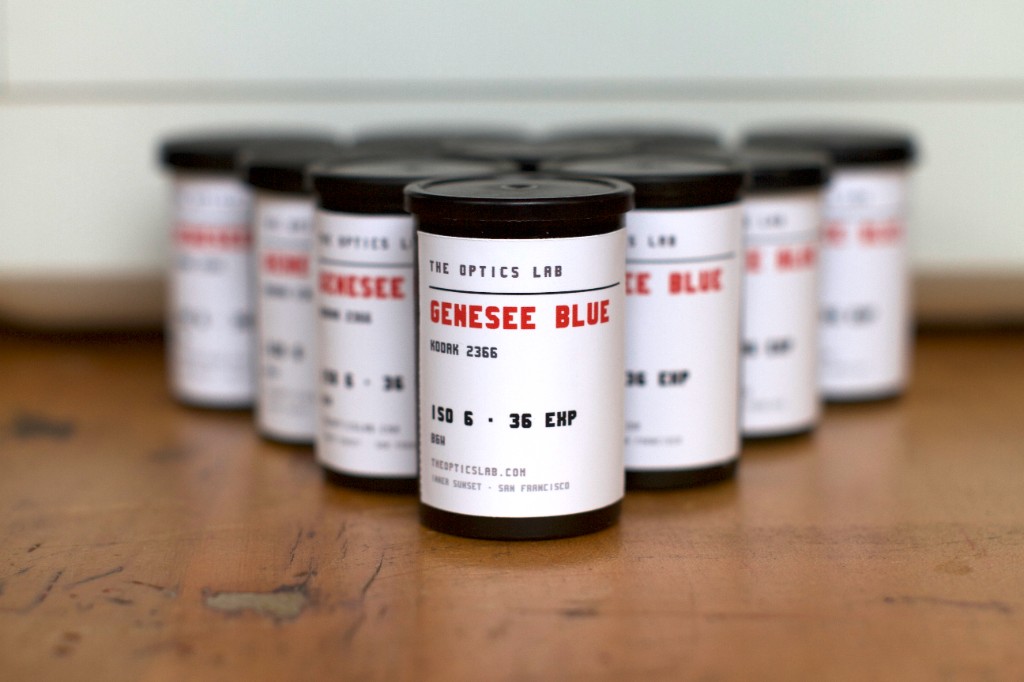
Our stock is new, cold-stored since purchase, with manufacturing dates around 2025. There is no age fog, no speed loss, no cold-storage uncertainty. The film is as fresh as anything Kodak makes — just not something Kodak makes available to still photographers through any normal retail path.
The stock is available in Film Factory. It is one of the more experimental films we carry — not a general-purpose emulsion, not a film for every subject, and not a film that will be forgiving if your metering is casual. But for photographers who want to see what blue-only sensitivity, invisible grain, and motion-picture-grade resolution look like in a still frame, there is nothing else quite like it.
Further reading:
- Kodak Eastman 2366 Datasheet (PDF) — Original Kodak specifications
- Casual Photophile: Eastman 2366 Review — Comprehensive pictorial review with sample images
- Kodak Technical Pan 2415 Notes — Another ultra-fine-grained Kodak specialty film, for comparison
Eastman 2366 is available as Genesee Blue in the Film Factory.
Optics Lab Genesee Blue
$11.99 · 35mm · 36 exp