Sakawa Pan Film Review: Fujifilm's 4771
Optics Lab Sakawa Pan
$13.99 · 35mm · 36 exp
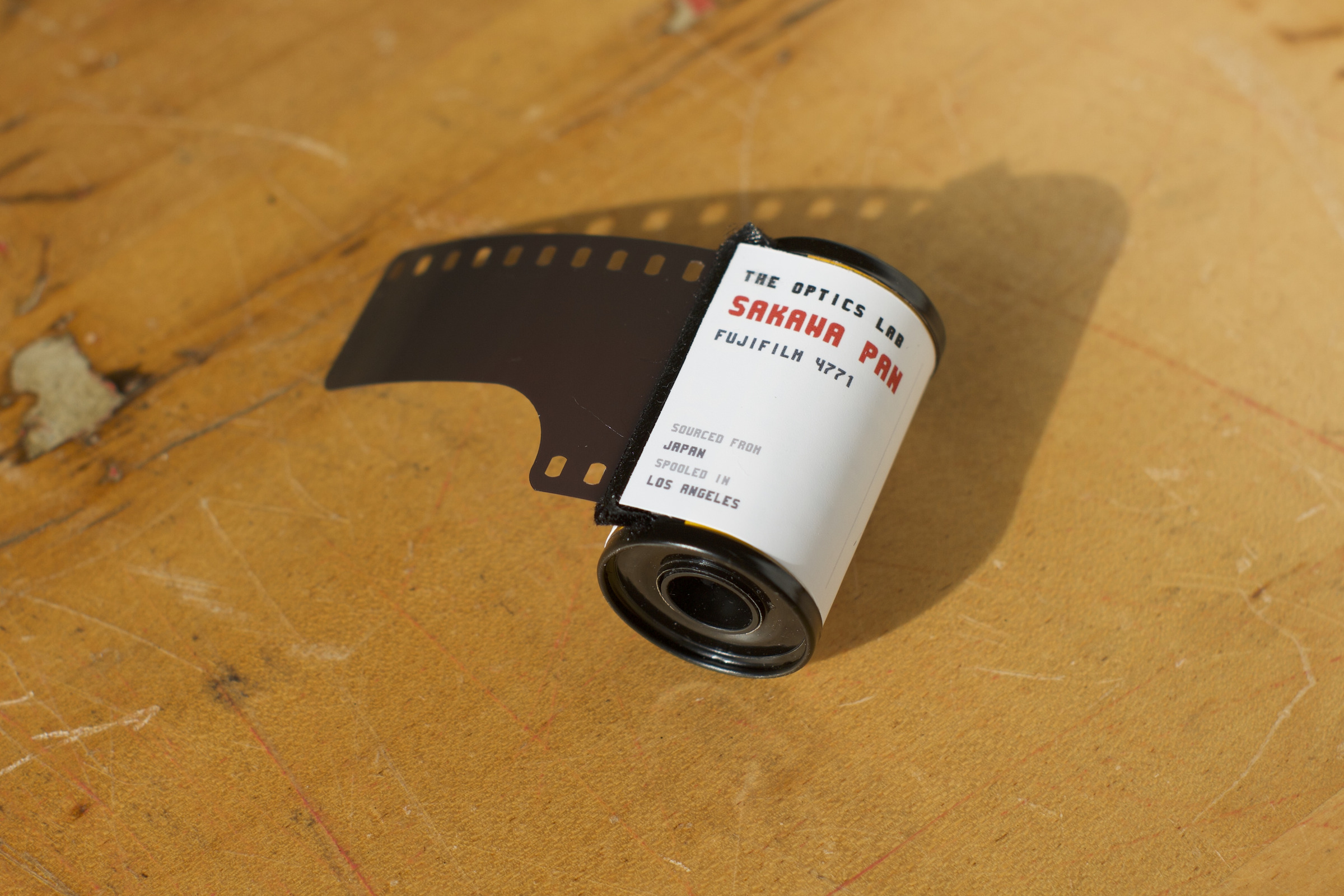
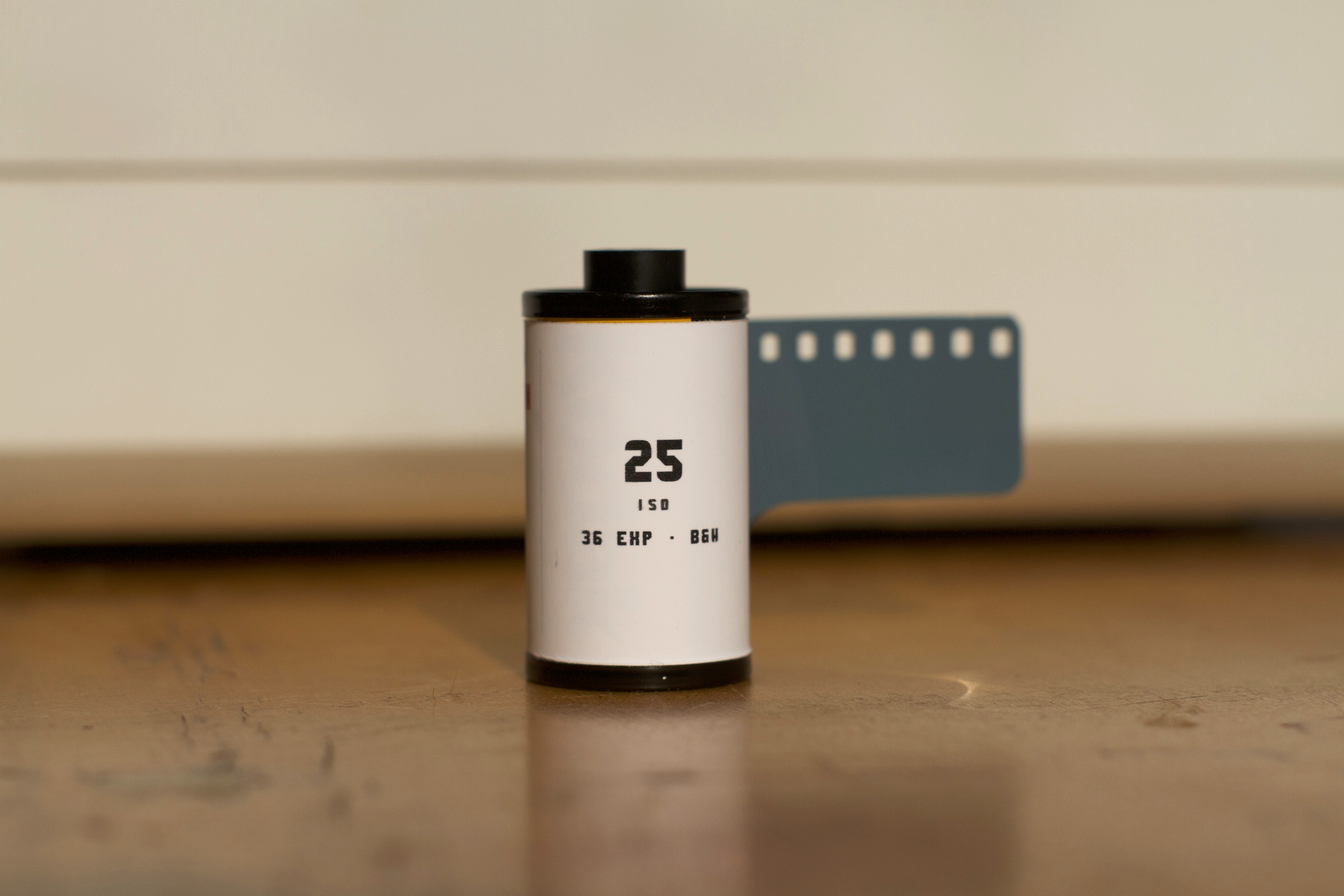
Sakawa Pan is available now in the Film Factory. This is our third original release — a high-contrast panchromatic black-and-white film based on Fujifilm 4771, a discontinued motion picture emulsion made in Japan. Bulk loaded to 135 by Koltin Sullivan in Los Angeles.
No currently available film offers what Sakawa Pan does: a panchromatic, ultra-high-resolution emulsion from the cinema pipeline, with virtually invisible grain, tunable contrast, and polyester archival stability.
This article covers the emulsion's history, what we found during testing, recommended development, and how to shoot it. For quick-reference specs, see the Sakawa Pan datasheet.
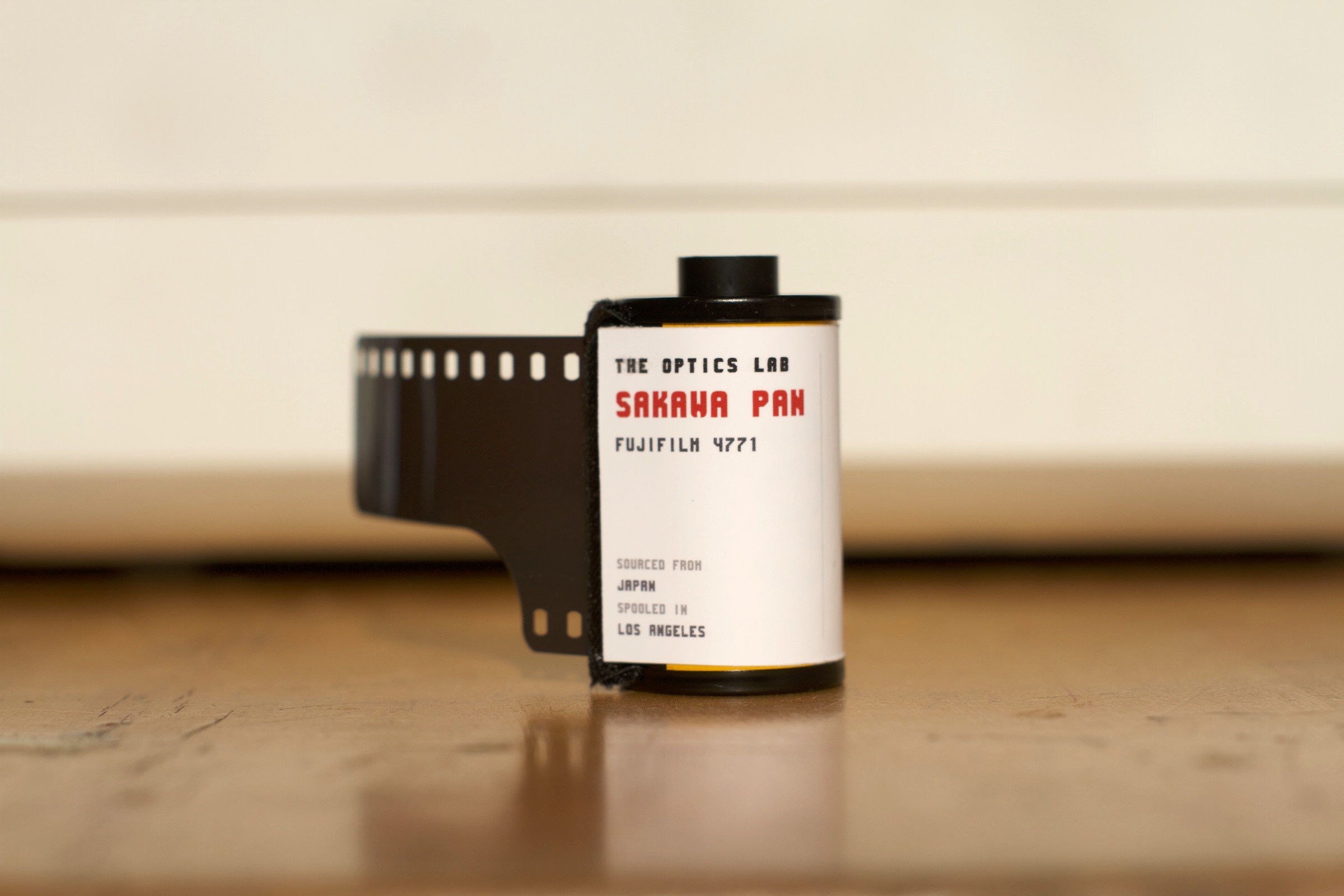
The emulsion
Sakawa Pan is based on Fujifilm 4771, designated "HC Panchro Polyester" — a high-contrast panchromatic motion picture film produced by Fujifilm in Japan. The 4771 belongs to Fuji's 47xx series of specialised black-and-white recording and intermediate films — a category that existed alongside the better-known Eterna colour negatives (85xx/86xx) and colour print stocks (35xx/36xx) in Fuji's motion picture catalogue. When Fujifilm ceased all motion picture film production on 31 March 2013, the 4771 went with it. No replacement exists.
The film is panchromatic with Class D spectral sensitivity — high response through green and yellow to approximately 625 nm. That distinguishes it from orthochromatic cinema stocks like Lomography's Fantôme Kino, which are blind to red. With a red filter (Wratten #25), skies darken dramatically while clouds and foliage stay separated — a combination this emulsion's resolving power can actually exploit.
High contrast panchromatic films like the 4771 were never conventional camera originals. They were built for the cinema optical-printing chain:
Travelling mattes — the physical predecessor to digital green screen. A foreground subject was photographed against a blue backing; HCP film with a red filter recorded the backing as white and the subject as black, producing a high-contrast silhouette matte for optical compositing. This is how the original Star Wars trilogy and countless other pre-digital effects were assembled.
Title cards and credit sequences — clean, high-contrast text for optical printing into release prints. Our specific roll was used for exactly this: a Hollywood film transfer house ran the 4771 for titling motion pictures.
Fuji's 4771 competed directly with Kodak's Eastman High Contrast Panchromatic Film 5369 — introduced in 1973, discontinued in 2011. The two stocks shared the same role and similar characteristics: extreme contrast, ultra-high resolving power, extremely fine grain, panchromatic sensitivity, clear polyester base with anti-halation undercoat. Kodak's 5369 is the most thoroughly documented HCP film in still photography literature; we use it as the reference point for understanding what our 4771 should do. Against Kodak Technical Pan — the still-photography benchmark for ultra-fine grain — the 4771's resolving power is estimated at 200–250+ lp/mm versus Technical Pan's 125 lp/mm. That gap is by design: the film was engineered for an optical printing chain where every duplication generation compounds resolution loss.
The 4771 is coated on polyester (PET), not acetate. In practice that means archival stability with no vinegar syndrome, complete flatness in scanners and enlargers, and a clear base that light-pipes easily — keep the roll in its black cassette until you are ready to load, work in subdued light, and take 2–3 blank frames at the start of each roll. There is no remjet; standard B&W tanks and chemistry are all you need. The emulsion itself is soft — it scratches easily and collects dust. Do not use film squeegees. Handle by the edges and rebate only, and hang to dry without touching the emulsion surface.
Test results
We commissioned Koltin Sullivan for bulk loading and lab testing — the same Los Angeles photographer and darkroom specialist who spooled Dnipro Pan. In testing at ISO 25 in HC-110 Dil. B (6:30 at 68°F / 20°C, distilled water, gentle inversions first 30 seconds then 1 inversion per minute), we bracketed the emulsion on a DKK reference chart at 1/30 sec across three apertures — one stop under, metered, and one stop over:
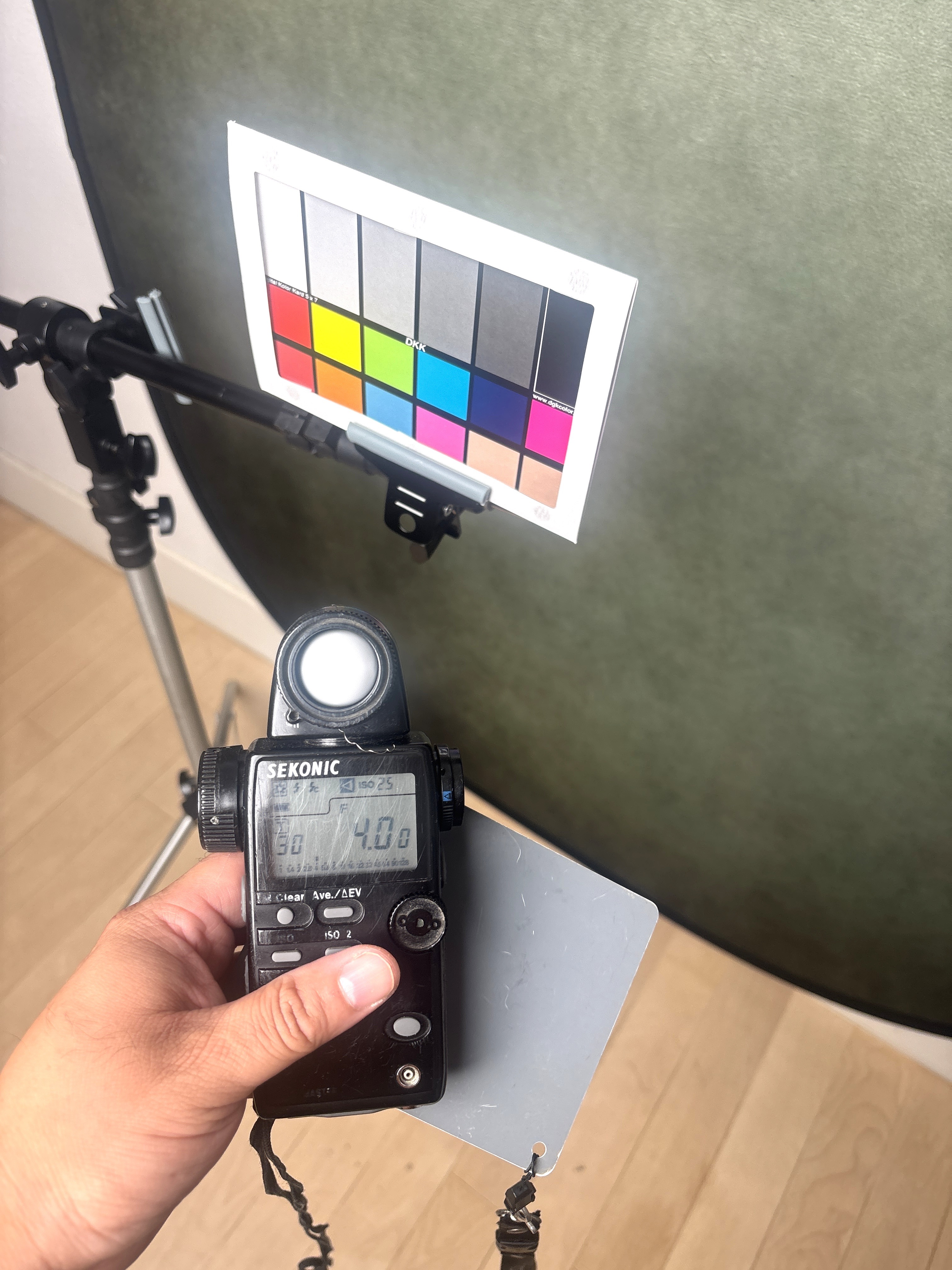 Meter reading for the bracket: ISO 25, 1/30 sec at f/4.0 — the baseline exposure. DKK reference chart on stand in the background.
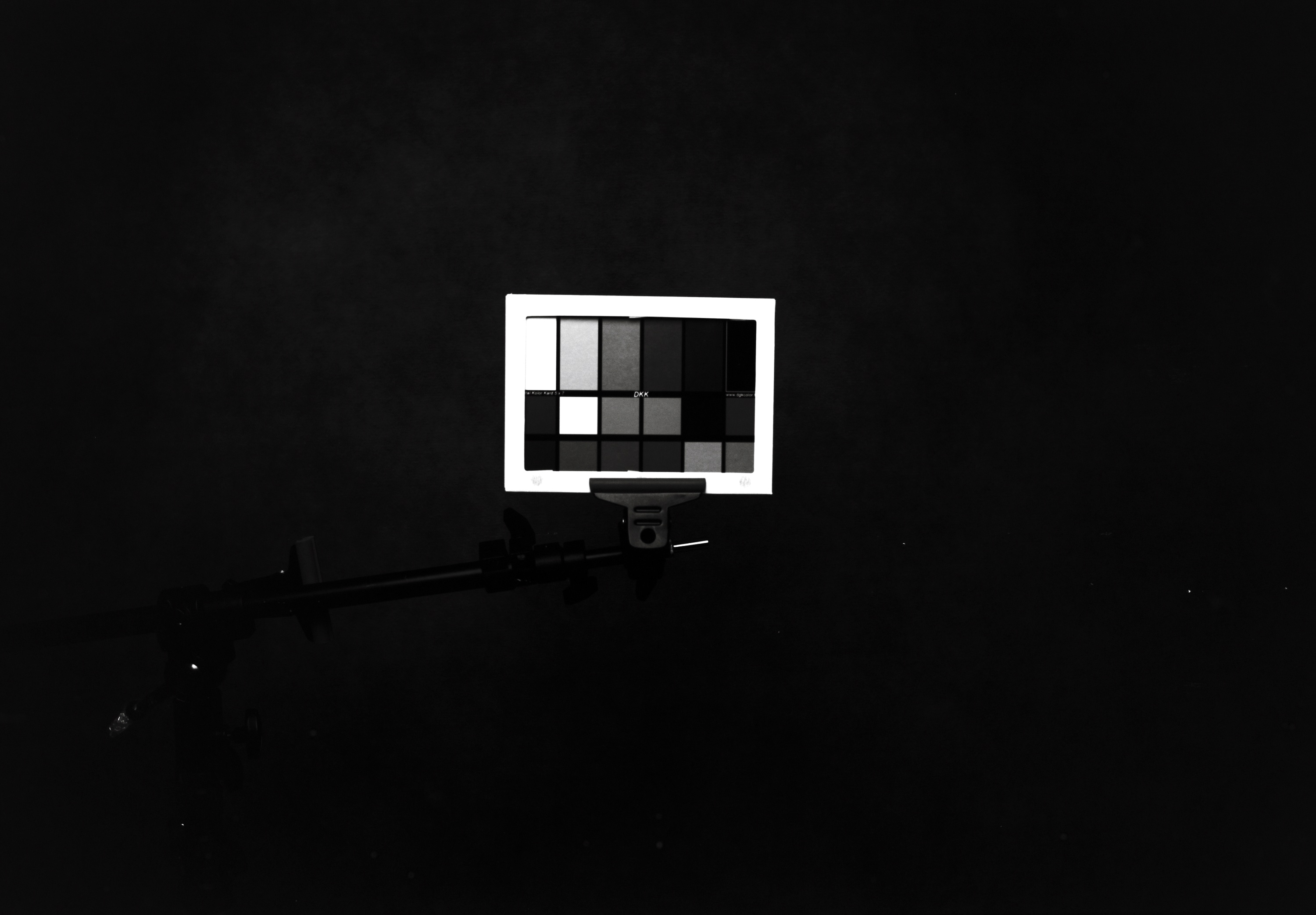
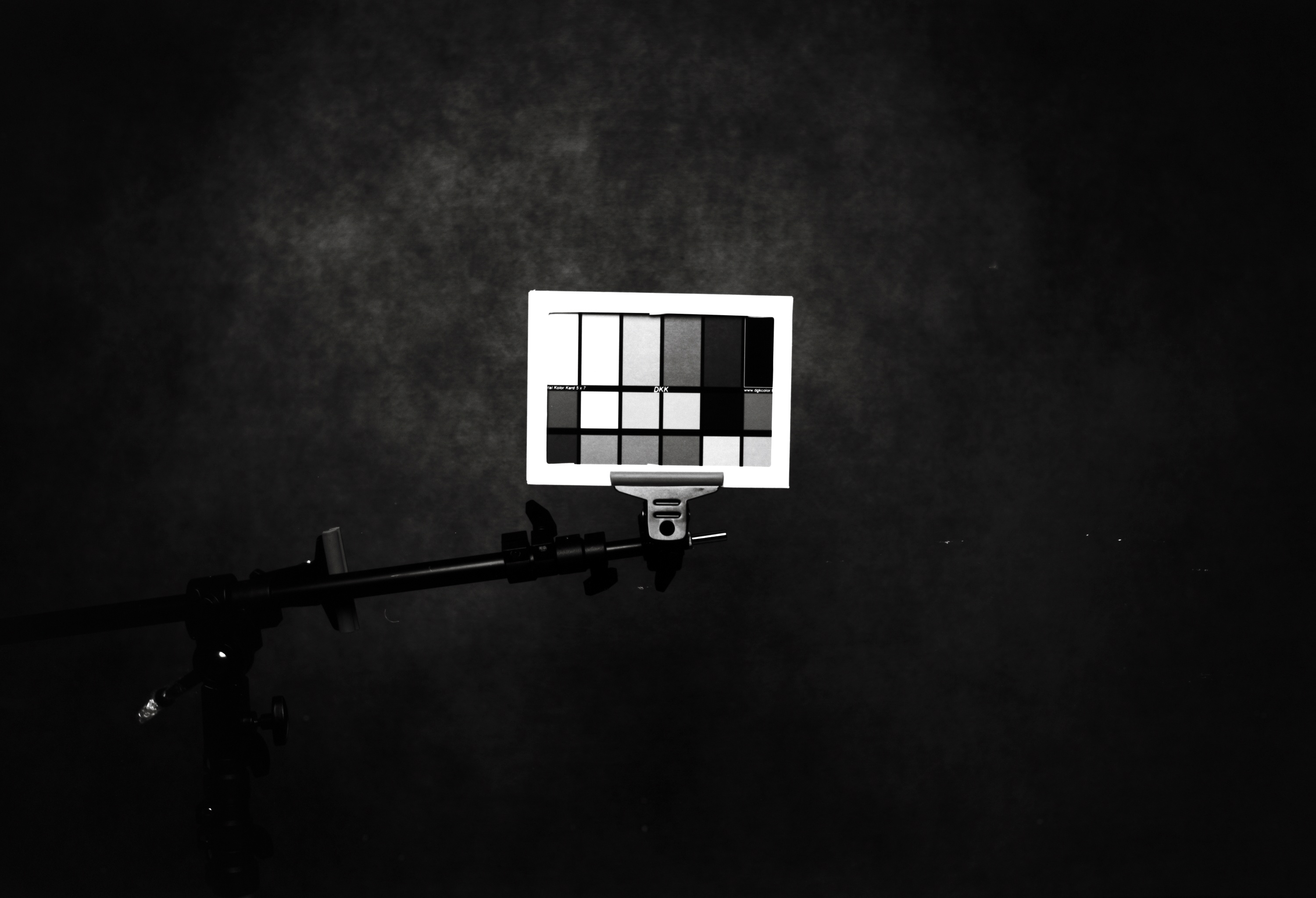
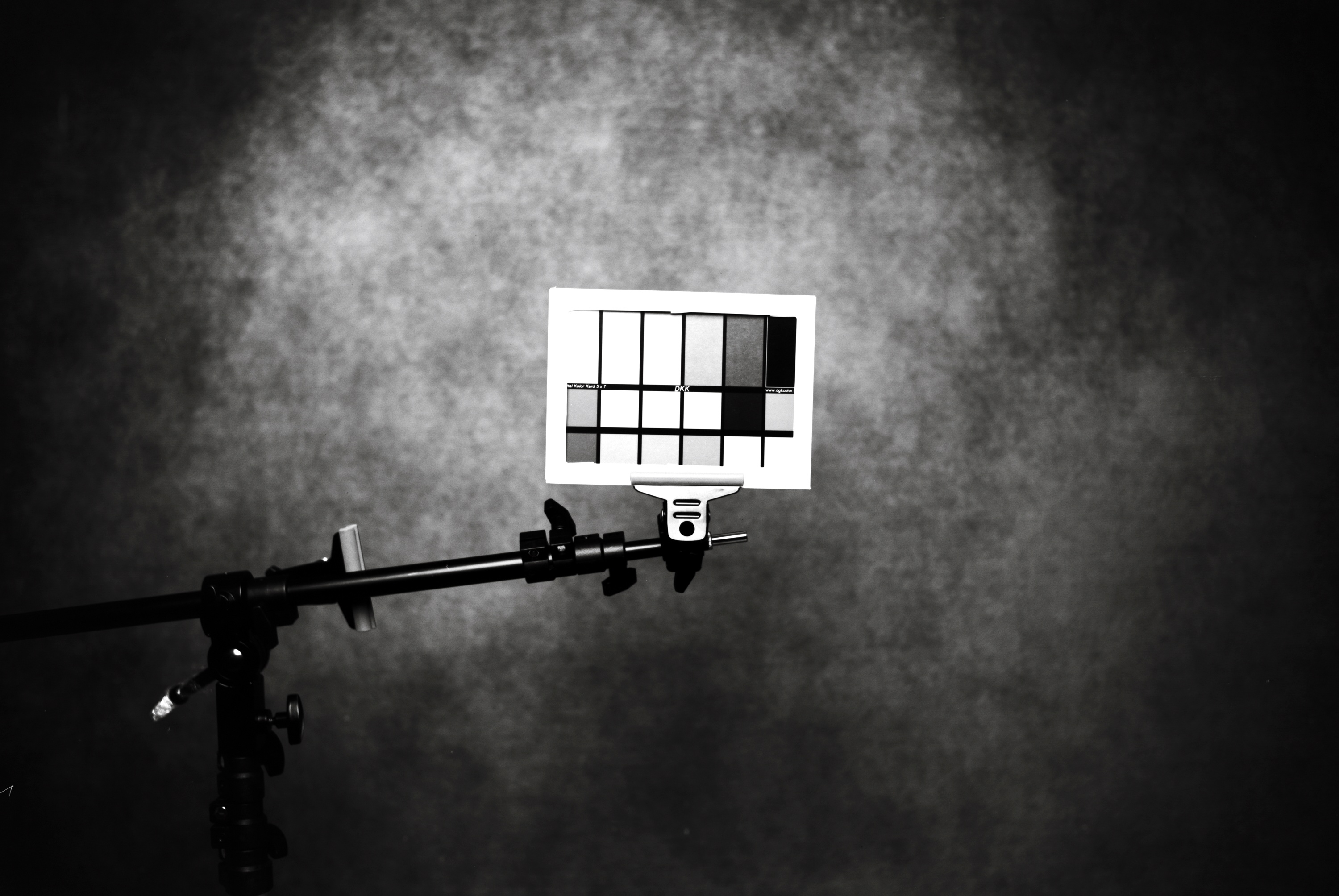
Exposure bracket on a DKK reference chart. HC-110 Dil. B, 6:30 at 20°C. −1 stop: underexposed. Metered at ISO 25: thin — the meter reading alone was insufficient. +1 stop: best result, with smooth tonal separation across the full grayscale.
What we found:
- Virtually invisible grain — finer than any modern 100-speed film in HC-110 testing
- High contrast and extreme sharpness in the confirmed HC-110 protocol
- Low base fog — clean negatives from sealed storage
- Resolving power estimated at 200–250+ lp/mm, consistent with the Kodak 5369 class
- Bulk loading: blue side is emulsion (faces the lens); black side is backing. Loading black-side-up produced very faint images
- Edge code: "FH HC 0250" reported as the consistent edge marking on this stock
A note on speed
Our box rating is ISO 25. Set your meter to box speed, then open one additional stop — aperture or shutter. That +1 stop produced our best negatives in testing. Without it, the film tends thin.
This emulsion has very narrow latitude. Each stop makes a dramatic difference. Treat it more like a slide film than a forgiving negative. Underexposure is the main risk; when in doubt, give more light, not more development time.
The original Fuji can rates the emulsion at N-4.740 (~ISO 6 in still photography terms). Our ISO 25 box rating reflects how the stock performs in pictorial use with modern developers — not the manufacturer's cinema notation for optical printing.
Field results
Daniel Roland Tierney shot these in the studio, metered at ISO 25. More sample photos →
 Studio portrait. Metered at ISO 25. Photographed by Daniel Roland Tierney.
 Same sitting, in profile.
He double-checked the datasheet before processing and saw the ISO 12 recommendation. Worried the roll was thin, he added about a minute in development — roughly a third of a stop.
"I would definitely shoot it again. It surprisingly has amazing latitude. I shot it at ISO 25, and didn't realize until I double-checked the datasheet for processing that the rating was recommended at ISO 12. So I was concerned and gave it an extra minute in the dev, I suppose pushing it a third of a stop. Probably was unnecessary, as it had plenty of dynamic range."
What to expect
Sakawa Pan is rated ISO 25. Set your meter to box speed, then give one additional stop of exposure. At that effective speed, bright sunlight at f/8–f/11 is comfortable handheld. Overcast and indoor work without flash is tripod territory. Reciprocity characteristics are not documented — bracket long exposures beyond 1 second.
Daylight starting points (meter at ISO 25, then open +1 stop from the reading):
- Bright sun: meter f/16 at 1/30 s → shoot f/11 at 1/30 s or f/16 at 1/15 s
- Hazy sun: meter f/11 at 1/30 s → shoot f/8 at 1/30 s
- Overcast: meter f/8 at 1/30 s → shoot f/5.6 at 1/30 s
- Heavy overcast / open shade: meter f/5.6 at 1/30 s → shoot f/4 at 1/30 s
What you get in return:
- Virtually invisible grain — finer than any 100-speed film you've shot
- Extreme resolving power — estimated 200–250+ lp/mm, exceeding Kodak Technical Pan
- Tunable contrast — graphic lith in D-97, smooth pictorial in HC-110 Dil. B
- Polyester base — flat-scanning, tear-resistant, archival
The closest living comparison is Lomography's Fantôme Kino ISO 8 — a high-contrast B&W cut from German cinema stock. But Fantôme is orthochromatic, currently in production, and readily available. Sakawa Pan is panchromatic, discontinued at source, and sealed since manufacture. On the premium end, Adox CMS 20 II (ISO 20) and Kodak Technical Pan (ISO 25, discontinued 2004) are the natural comparisons. Technical Pan trades at $20–40/roll on the secondary market when it appears at all.
If you've never shot anything this slow or this contrasty, don't be intimidated. The worst thing you can do with Sakawa Pan is underexpose it. Give it light and it will reward you.
Development recommendations
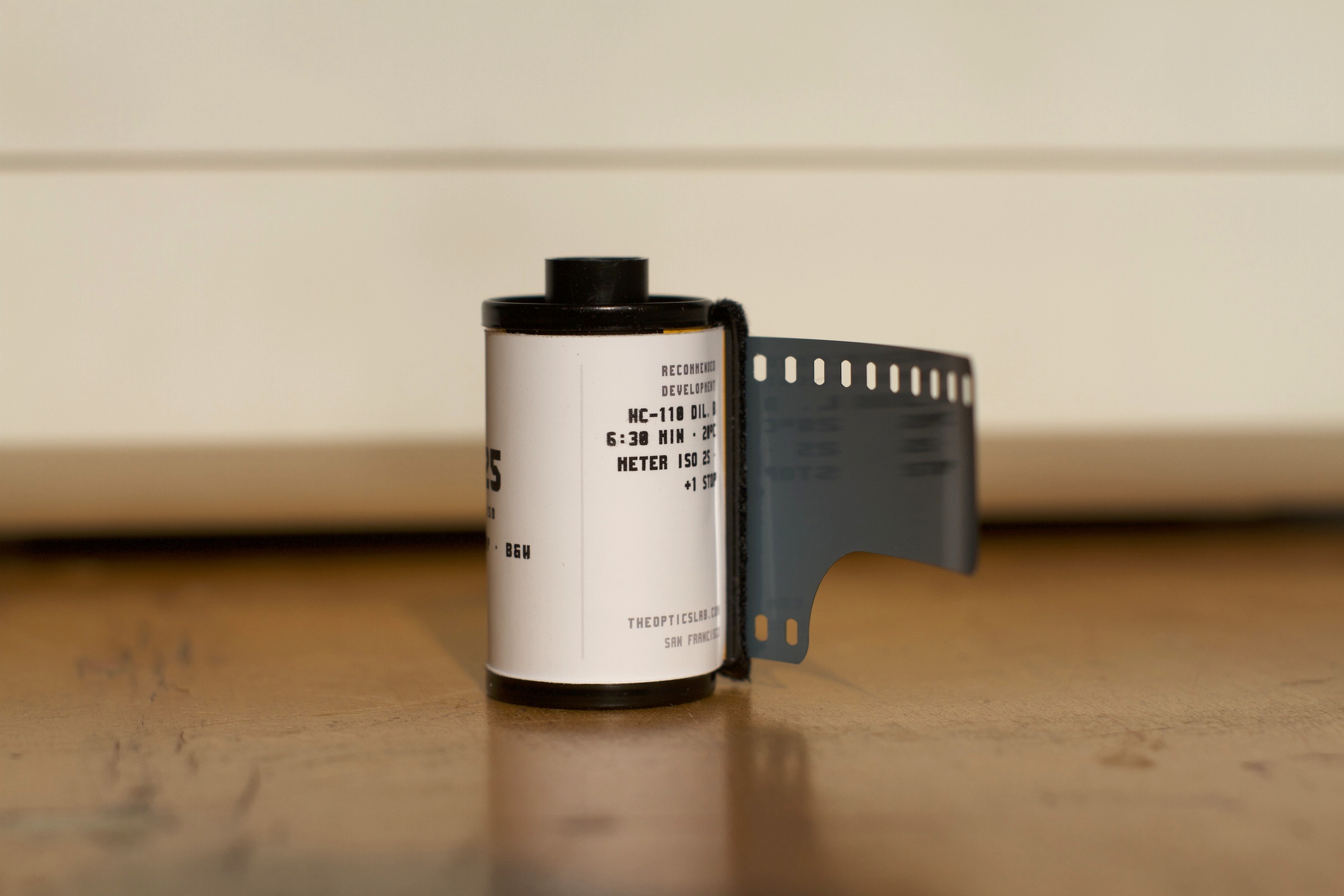
Sakawa Pan is a standard silver gelatin B&W negative — no remjet, no special chemistry. If you can develop Tri-X, you can develop this.
Safelight: none. Sakawa Pan is panchromatic — it sees all colors of visible light, including red. Load your developing reels and handle the film in total darkness until it is fully fixed. No safelight of any color is safe.
Tested
- HC-110 (Dilution B) — 6:30 at 20°C (68°F), distilled water. Gentle inversions first 30 seconds, then 1 inversion per minute. Meter at ISO 25, open +1 stop. This is our confirmed pictorial protocol from lab testing on this 4771 stock. Results were clean with high contrast and extreme sharpness.
Suggested starting points
The following developers have not all been validated on our specific coating run but are reasonable starting points from the Kodak 5369 literature, community reports, or comparable HCP stocks. Bracket your first roll in any developer we have not marked confirmed:
- Rodinal (1+50) — 14 minutes at 20°C, gentle agitation. User-confirmed on this stock.
- D-97 (stock) — ~6 minutes at 20°C. Inferred from Kodak 5369 equivalent. Maximum contrast / graphic path — steep gamma (~3.6), near-binary contrast, deep blacks, blown highlights. The motion-picture look: architecture, abstraction, title-card geometry.
- Pyrocat-HD (2:2:100) — ~11 minutes at 20°C. Compensating; tames contrast while preserving sharpness. Pictorial path alongside HC-110 and Rodinal.
- D-76 / ID-11 (1+1) — 8–10 minutes at 20°C (estimated). Finer grain; slightly reduced speed.
- Xtol (stock) — ~5:45 at 20°C. Inferred from Kodak 5369 equivalent.
Developer choice is the most important creative decision with this emulsion. The same roll of film can read as graphic lith or smooth pictorial depending entirely on your developer — you can dive in more deeply into technical development notes in our datasheet.
General guidance
- Overexpose, don't overdevelop: underexposure is the main failure mode
- Agitation: consistent and gentle — the emulsion scratches easily
- Drying: no squeegees; Photo-Flo and hang dry
- Light piping: this stock light-pipes easily on its clear polyester base. Keep the roll in its black cassette until loading, work in subdued light, and take 2–3 blank frames at the start of each roll
- Bubble artifacts have been reported by some users but are likely technique-related (residual wetting agent, incorrect chemistry volume). Our test results were clean with standard processing
This article serves as our development and metering reference for Sakawa Pan — we'll update it as we test additional developers. We recommend bookmarking it or pulling it up before your first roll.
From Ashigara
We acquired our stock — a single sealed 2000ft roll of Fujifilm 4771 — from a seller whose building had housed a professional film transfer business that worked exclusively with Hollywood studios. The business used 4771 for titling motion pictures and producing dailies for studio executives. When the industry went almost entirely digital, the transfer house closed and left behind its equipment and supplies, including this roll.
There is very little public information about the 4771. Unlike the well-documented Eterna line, this stock existed entirely within the professional cinema pipeline — sold in bulk to post-production houses, never reaching the consumer market.
The can label reads "HC Panchro Polyester" and records the full production data: stock 4771, emulsion number 738-01, lot 501-08, 610 meters (2000ft), BH-1866 perforation, exposure index N-4.740. Critically, the single emulsion number means every roll we load comes from the same coating run — no batch-to-batch variation.
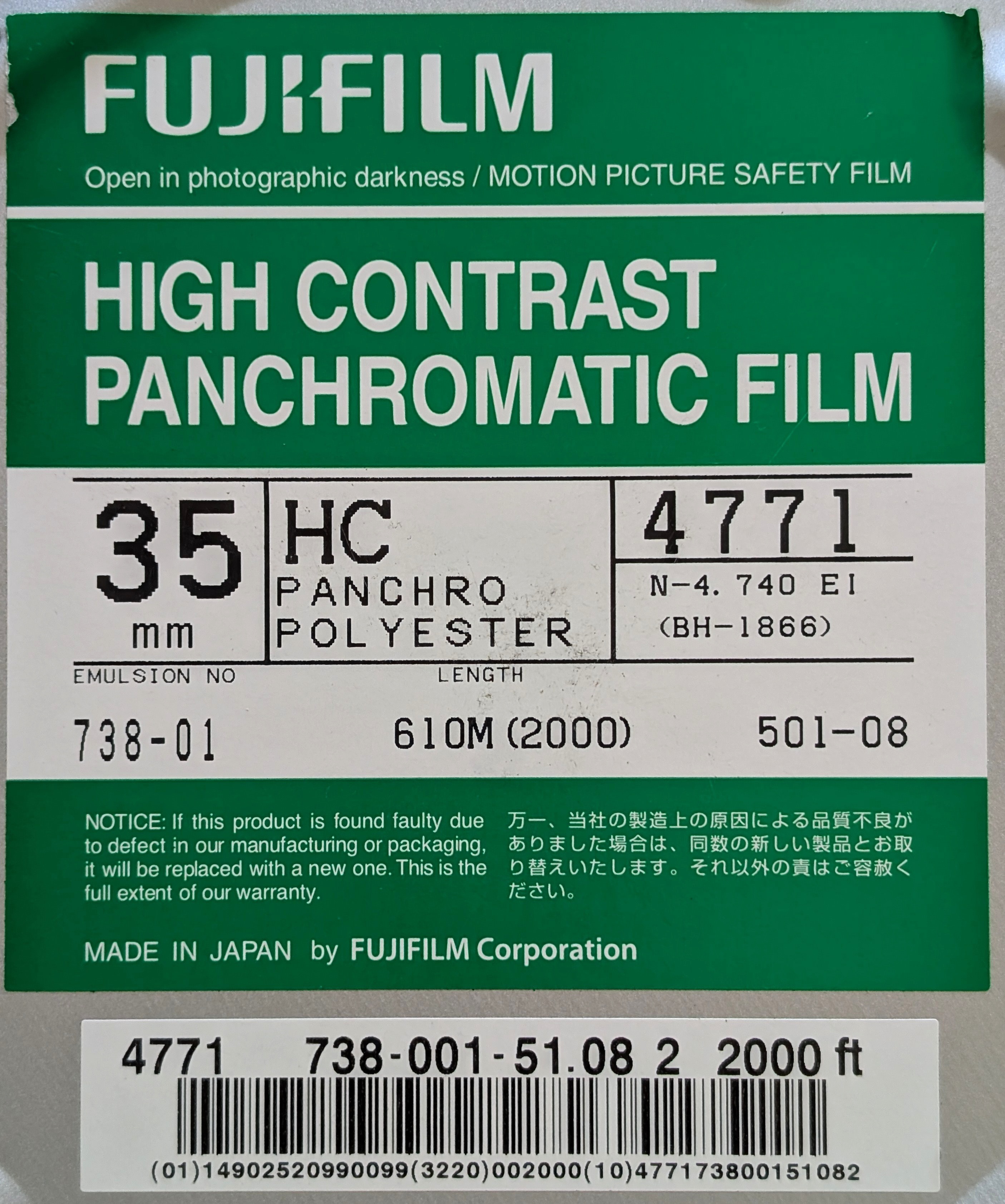 Factory label from our 4771 bulk roll. Fujifilm 4771 — HC Panchro Polyester, 35 mm. Emulsion 738-01, lot 501-08, 610 m (2000 ft), BH-1866 perforation, exposure index N-4.740. Made in Japan by Fujifilm Corporation.
The name — Sakawa Pan — comes from the Sakawa River (酒匂川), which flows through Minami-Ashigara in Kanagawa Prefecture, past the Fujifilm Ashigara factory where this emulsion was coated. Pan is panchromatic — sensitive to the full visible spectrum.
Availability & pricing
Sakawa Pan is available now in the Film Factory. Each roll is bulk loaded 35mm (135 format), 36 exposures, not DX coded, rated ISO 25, by Koltin Sullivan in Los Angeles. $13.99 per roll.
Sign up for our newsletter for restock alerts and new Film Factory releases.
Optics Lab Sakawa Pan
$13.99 · 35mm · 36 exp